
In studies of adults, growth hormone changed metabolism after one month and body composition after 6 months. Bone density needed a year to return to its starting value after a temporary dip. In the placebo-controlled study body weight did not change, because fat went down while lean mass went up. Below you will find a timeline from clinical studies of somatropin, from the first month to two years. Every stage comes with concrete numbers and a source.
What changes in the first month?
The first measurable change concerns metabolism. In a 1989 study, 24 adults with growth hormone deficiency received somatropin or placebo for 6 months. Basal metabolic rate rose after the first month from 32.4 to 37.2 kcal per kilogram of lean mass per day. After 6 months it was 34.4 kcal, and the difference from baseline was significant at both measurements.
Over the same period IGF-1 rises, the protein through which growth hormone produces a large part of its effects. In this study IGF-1 rose on average from 0.41 to 1.53 units per litre. The Genotropin label says to check IGF-1 and adjust the dose every 1 to 2 months. How IGF-1 and body composition are measured is described in how to measure peptide results.
What did studies show after 6 months?
After half a year the change in body composition becomes visible. Three studies measured it in different groups:
| Study | Who | Lean body mass | Fat tissue |
|---|---|---|---|
| Salomon 1989 | 24 adults with deficiency, with placebo | plus 5.5 kg | minus 5.7 kg |
| Rudman 1990 | 21 men aged 61-81 with low IGF-1 | plus 8.8 percent | minus 14.4 percent |
| Blackman 2002 | 131 healthy people aged 65-88, with placebo | men plus 3.1 kg, women plus 1.0 kg | significant fall in both sexes |
In the Salomon study body weight did not change. Almost as much fat was lost as lean mass was gained. In the placebo group neither lean mass nor fat changed.
The Genotropin label describes the same picture in six studies with 172 adults. After 6 months lean body mass, total body water and the lean-to-fat ratio rose. Total body fat and waist circumference fell.
Do skin and bones change after 6 months?
In the Rudman study, lumbar spine density rose by 1.6 percent after 6 months. Bone density of the forearm and upper femur did not change. Skin, the epidermis together with the dermis, was 7.1 percent thicker, although this difference was at the edge of statistical significance.
The authors concluded that reduced growth hormone secretion is partly responsible for the loss of lean mass, the gain in fat and the thinning of the skin in old age. What happens to this axis after forty is described in Peptides after 40.
What happens to bone after a year?
Bone responds most slowly and in two stages. According to the Genotropin label, bone mineral density in adults with deficiency fell after 6 months of treatment and returned to baseline after 12 months.
During the same period bone is remodelled faster. A Swedish study from 1995 included 68 adults with growth hormone deficiency. The authors measured bone turnover markers, blood indicators showing how fast bone is broken down and rebuilt. Over 12 months of treatment they found increased bone turnover.
Do the effects last longer than a year?
Yes, in studies with longer follow-up. The Genotropin label states that after the 6-month placebo phase patients could continue treatment for up to 24 months in total. The changes in body composition were maintained throughout.
The 2011 Endocrine Society guideline names four benefits of treatment in adults with deficiency: better body composition, greater exercise capacity, a stronger skeleton and better quality of life. According to the guideline, people with the most severe deficiency gain the most.
When does well-being improve?
Well-being was measured in a Swedish study from 1995. It included 36 adults with deficiency who received growth hormone or placebo in a crossover design over a total of 21 months. On growth hormone the symptom questionnaire score improved from 89 to 80.2 points. Anxiety, fearfulness and cognition changed most, and in a second questionnaire energy and emotions.
The authors attributed part of the improvement to a placebo effect, because the score also improved on placebo, though less. The changes were confirmed by the patients' spouses, who in a separate survey saw better mood and behaviour on growth hormone.
What about muscle strength?
Strength rose more slowly than lean mass. In the Blackman study from 2002, after 26 weeks only men on growth hormone plus testosterone had a gain in strength close to significance, 13.5 kg. In the same group aerobic capacity rose significantly. The change in strength went hand in hand with the change in lean mass.
More lean mass therefore did not turn into more strength straight away. Strength and endurance were measured separately from body composition.
What does the whole timeline look like?
| Time | What was measured | Source |
|---|---|---|
| 1 month | higher metabolic rate, rising IGF-1 | Salomon 1989 |
| 1-2 months | IGF-1 check and dose adjustment | Genotropin label |
| 6 months | more lean mass, less fat, smaller waist, stable body weight | Salomon 1989, Rudman 1990, Blackman 2002, label |
| 6 months | temporary dip in bone density in people with deficiency | Genotropin label |
| 12 months | bone density back at baseline | Genotropin label |
| up to 21-24 months | body composition maintained, better well-being | Genotropin label, Burman 1995 |
Where to buy somatropin and what about peptides?
All the numbers above concern somatropin, the ready-made hormone. The shop has two versions: rHGH 4 mg (12 IU) by Bio-Peptide for 25 EUR and rHGH 12 mg (36 IU) by Nouveaux Ltd. for 90 EUR. How to dissolve them and how many units are in a millilitre is covered in rHGH 4 mg and 12 mg: how to reconstitute.
Peptides that stimulate the pituitary work at a different rhythm, and the differences are covered in rHGH vs growth hormone peptides. Somatropin is the active ingredient of prescription drugs, while the products in the shop are research material, not medicines. Growth hormone is banned in sport all year round.
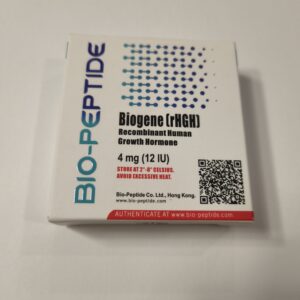
rHGH 4 mg (12 IU) by Bio-Peptide
25 EUR100,00 złAdd to cartIn stock
Ships within 24 h
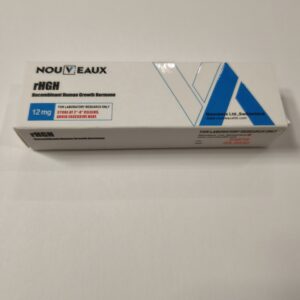
rHGH 12 mg (36 IU) by Nouveaux Ltd.
90 EUR350,00 złAdd to cartIn stock
Ships within 24 h
Frequently asked questions
How long does growth hormone take to show results?
In studies of adults, metabolic rate rose after one month, and body composition changed clearly after 6 months, with more lean mass and less fat.
How much fat was lost in growth hormone studies?
In the 1989 Salomon study it was 5.7 kg after 6 months, with a gain of 5.5 kg of lean mass. In the 1990 Rudman study fat tissue was 14.4 percent lower.
Does growth hormone change body weight?
In the Salomon study body weight did not change. Fat went down and lean mass went up by a similar amount.
When does growth hormone act on bone?
Bone responds last of all the measured parameters. According to the Genotropin label, bone density dipped after 6 months and returned to baseline after 12 months.
Does growth hormone increase strength?
Strength rises more slowly than muscle mass. In the Blackman study, after 26 weeks only men on growth hormone plus testosterone had a gain in strength of 13.5 kg, close to significance.
Sources
- Salomon F, Cuneo RC, Hesp R, Sönksen PH. The effects of treatment with recombinant human growth hormone on body composition and metabolism in adults with growth hormone deficiency. New England Journal of Medicine, 1989, 321(26): 1797-1803. https://pubmed.ncbi.nlm.nih.gov/2687691/
- Rudman D, Feller AG, Nagraj HS et al. Effects of human growth hormone in men over 60 years old. New England Journal of Medicine, 1990, 323(1): 1-6. https://pubmed.ncbi.nlm.nih.gov/2355952/
- Blackman MR, Sorkin JD, Münzer T et al. Growth hormone and sex steroid administration in healthy aged women and men: a randomized controlled trial. JAMA, 2002, 288(18): 2282-2292. https://pubmed.ncbi.nlm.nih.gov/12425705/
- Degerblad M, Bengtsson BA, Bramnert M et al. Reduced bone mineral density in adults with growth hormone (GH) deficiency: increased bone turnover during 12 months of GH substitution therapy. European Journal of Endocrinology, 1995, 133(2): 180-188. https://pubmed.ncbi.nlm.nih.gov/7655642/
- Burman P, Broman JE, Hetta J et al. Quality of life in adults with growth hormone (GH) deficiency: response to treatment with recombinant human GH in a placebo-controlled 21-month trial. Journal of Clinical Endocrinology and Metabolism, 1995, 80(12): 3585-3590. https://pubmed.ncbi.nlm.nih.gov/8530603/
- Molitch ME, Clemmons DR, Malozowski S et al. Evaluation and treatment of adult growth hormone deficiency: an Endocrine Society clinical practice guideline. Journal of Clinical Endocrinology and Metabolism, 2011, 96(6): 1587-1609. https://pubmed.ncbi.nlm.nih.gov/21602453/
- GENOTROPIN (somatropin) for injection, prescribing information, Pfizer, version of 4 August 2026, sections 2.2 and 14.1 (DailyMed, set ID ffebf88b-d257-4542-9808-74d9b7167765). https://dailymed.nlm.nih.gov/dailymed/drugInfo.cfm?setid=ffebf88b-d257-4542-9808-74d9b7167765