Epithalon is a short peptide of four amino acids, modelled on peptides of the pineal gland. In the scientific literature it usually appears as epitalon. In cultures of human cells it switched on telomerase and lengthened telomeres, and in mice it extended maximum lifespan by 12.3 percent. In older people it restored the night-time release of melatonin. Below you will find what these studies showed, in which model they were done and what the 10 mg vial in the shop contains.
What is Epithalon?
Epithalon is a tetrapeptide, a chain of four amino acids: alanine, glutamic acid, aspartic acid and glycine. It is written for short as AEDG or Ala-Glu-Asp-Gly. It was designed on the basis of the amino acid composition of epithalamin, a peptide extract of the pineal gland.
A 2026 review clearly separates the two compounds. Epithalamin is a mixture of many peptides, while epitalon is one synthetic peptide with a precisely defined structure. Results for epithalamin are therefore not automatically results for epitalon, and this guide focuses on studies of epitalon itself.
What does Epithalon act on in studies?
Studies of epitalon cover three areas linked to ageing:
- telomeres and telomerase in human cells,
- lifespan and chromosome damage in mice,
- night-time melatonin release in old monkeys and older people.
The 2026 review also mentions effects on oxidative stress and markers of cell ageing. Each of the three main areas has its own section below.
Does Epithalon lengthen telomeres?
In cultures of human cells it does, as two independent teams have shown. Telomeres are the ends of chromosomes, which shorten with every cell division. Telomerase is an enzyme that can rebuild them, but in most of our adult cells it is switched off.
In a 2003 study researchers added epitalon to cultures of human fetal fibroblasts that had no telomerase. The cells began to produce its catalytic subunit, the enzyme became active and the telomeres lengthened. In 2025 a team at Brunel University London confirmed telomere lengthening in normal human epithelial cells and fibroblasts. The effect grew with the dose and went through higher expression of the hTERT gene and higher telomerase activity.
What does it mean that Epithalon shifts the Hayflick limit?
The Hayflick limit is the number of divisions after which a cell stops dividing because its telomeres are too short. In a 2004 study, lung fibroblasts taken from a 24-week fetus lost the ability to divide at the 34th passage, the 34th transfer of the culture.
After epitalon was added to the ageing cells, their telomeres returned to the length seen in early passages. The cells made 10 more divisions, reaching the 44th passage, and kept dividing.
What did studies in mice show?
In a 2003 study, female SHR mice received epitalon on 5 consecutive days every month, from the 3rd month of life until natural death. Each group had 54 animals.
| What was measured | Result compared with controls |
|---|---|
| maximum lifespan | 12.3 percent longer |
| lifespan of the last 10 percent of survivors | 13.3 percent longer |
| chromosome aberrations in bone marrow cells | 17.1 percent fewer |
| age-related loss of the oestrous cycle | slower |
| leukaemia | 6 times less frequent |
| food intake and body weight | unchanged |
Mean lifespan of the mice did not change. The end of the survival curve shifted, so the longest-lived animals lived even longer. The authors saw the results as evidence of a protective effect against ageing and of the safety of long-term use in mice.
Does Epithalon help with sleep?
Sleep itself was not measured in the studies described here, but melatonin, the hormone of the daily rhythm, was. With age our pineal gland releases less melatonin at night and its daily rhythm flattens. In a 2007 study pineal preparations, epithalamin and epitalon, restored night-time melatonin release in old monkeys and older people. The rhythm of the hormone in the blood returned to normal.
In people melatonin rose mainly where the pineal gland worked less well. According to the 2026 review, the epitalon group had 15 people who received 0.01 mg a day for 10 days. In July 2026 an FDA advisory committee voted to add epitalon to the US list of substances for compounded medicines, with insomnia as the indication. This is an advisory opinion, not approval of a drug. Sleep studies on growth hormone peptides are collected in Growth hormone peptides and sleep.
How strong is the evidence in humans?
The 2026 review rates it as modest. In humans there are small studies of biomarkers such as melatonin and an older controlled study in retinitis pigmentosa. A large randomised trial confirming therapeutic efficacy has not yet been carried out.
Data on how long epitalon stays in the human body are also missing. The review authors described epitalon as biologically active but clinically unproven. How to read such assessments is explained in how to read a peptide study.
What is in the Epithalon 10 mg vial?
The shop has one version: Epithalon 10 mg by Bio-Peptide for 35 EUR. The kit contains a vial with 10 mg of lyophilisate and two 1 ml solvent ampoules. You can check authenticity with the code on the pack on the manufacturer's website.
| Solvent | Concentration | Per 1 U-100 syringe unit |
|---|---|---|
| 1 ml | 10 mg/ml | 100 mcg |
| 2 ml | 5 mg/ml | 50 mcg |
These numbers are plain concentration arithmetic, not a dosing recommendation. Add the solvent slowly down the side of the vial without shaking, and keep the ready solution in the refrigerator at 2-8 degrees. Details are in how to reconstitute peptides and how to store peptides. Everything about the compound is on the Epithalon page.
Epithalon is not an approved medicine in the European Union or the United States and is sold as research material. The WADA 2026 list does not name it. Its group S0, however, covers substances without approval for human use, so an athlete subject to testing should ask their anti-doping organisation about it.
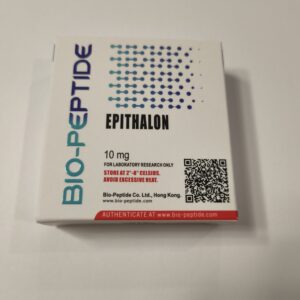
Epithalon 10 mg by Bio-Peptide
35 EUR139,00 złAdd to cartIn stock
Ships within 24 h
Frequently asked questions
What is Epithalon?
It is a synthetic peptide of four amino acids, Ala-Glu-Asp-Gly, modelled on epithalamin, a pineal gland extract. In the literature it is usually called epitalon.
How does Epithalon differ from epithalamin?
Epithalamin is an extract of many pineal peptides. Epithalon is one synthetic peptide with a defined structure, designed on its model.
Does Epithalon lengthen telomeres in humans?
In cultures of human cells it does, as two independent teams confirmed in 2003 and 2025. No studies measuring telomeres in people after epitalon have been published.
Does Epithalon affect sleep?
Sleep itself was not measured in the studies described. In old monkeys and older people epitalon restored night-time release of melatonin, the hormone of the daily rhythm.
How much does Epithalon cost in the shop?
The 10 mg vial by Bio-Peptide with two solvent ampoules costs 35 EUR.
Sources
- Khavinson VKh, Bondarev IE, Butyugov AA. Epithalon peptide induces telomerase activity and telomere elongation in human somatic cells. Bulletin of Experimental Biology and Medicine, 2003, 135(6): 590-592. https://pubmed.ncbi.nlm.nih.gov/12937682/
- Khavinson VKh, Bondarev IE, Butyugov AA, Smirnova TD. Peptide promotes overcoming of the division limit in human somatic cell. Bulletin of Experimental Biology and Medicine, 2004, 137(5): 503-506. https://pubmed.ncbi.nlm.nih.gov/15455129/
- Anisimov VN, Khavinson VKh, Popovich IG et al. Effect of Epitalon on biomarkers of aging, life span and spontaneous tumor incidence in female Swiss-derived SHR mice. Biogerontology, 2003, 4(4): 193-202. https://pubmed.ncbi.nlm.nih.gov/14501183/
- Korkushko OV, Lapin BA, Goncharova ND et al. Normalizing effect of the pineal gland peptides on the daily melatonin rhythm in old monkeys and elderly people. Advances in Gerontology, 2007, 20(1): 74-85. https://pubmed.ncbi.nlm.nih.gov/17969590/
- Al-Dulaimi S, Thomas R, Matta S, Roberts T. Epitalon increases telomere length in human cell lines through telomerase upregulation or ALT activity. Biogerontology, 2025, 26(5): 178. https://pubmed.ncbi.nlm.nih.gov/40908429/
- Jain A, Gallacher DM, Issa MA et al. Epitalon and Epithalamin: A Narrative Review of Mechanistic, Preclinical, and Clinical Evidence. International Journal of Molecular Sciences, 2026, 27(19): 8922. https://doi.org/10.3390/ijms27198922