IGF-1 LR3 1 mg dissolved in 1 ml gives 1000 mcg per millilitre, which is 10 mcg per unit of a U-100 insulin syringe. The same vial in 2 ml gives 500 mcg per millilitre and 5 mcg per unit. IGF-1 LR3 is sold by the milligram but measured in micrograms, so concentration matters more here than with other peptides. Below you will find a conversion table, step-by-step preparation and a comparison of the three versions in the shop.
What is IGF-1 LR3?
IGF-1 LR3 is a modified analogue of IGF-1, insulin-like growth factor 1. It was developed by a CSIRO team in Adelaide. In the molecule the third amino acid was replaced with arginine, and a short segment of 13 amino acids was added at the start.
Because of this IGF-1 LR3 binds weakly to the proteins that hold natural IGF-1 inactive in our blood. In rat studies from 1992 it was about 2.5 times more potent than IGF-1. The results of this work are collected in IGF-1 LR3: results in studies, and the difference from the other variant is in IGF-1 LR3 vs DES(1-3) IGF-1.
How many mcg are in a millilitre after reconstitution?
The calculation is simple. You divide 1000 mcg, which is 1 mg, by the number of millilitres of liquid. A U-100 insulin syringe has 100 units per 1 ml, so one unit is 0.01 ml.
| Liquid | Concentration | Per 1 U-100 unit | Per 10 U-100 units |
|---|---|---|---|
| 1 ml | 1000 mcg/ml | 10 mcg | 100 mcg |
| 2 ml | 500 mcg/ml | 5 mcg | 50 mcg |
These numbers are plain concentration arithmetic, not a dosing recommendation. No clinical studies of IGF-1 LR3 in humans have been done, so there is no dose to refer to. Conversion for other peptides is in converting a peptide dose to syringe units.
Why does concentration matter so much with IGF-1 LR3?
Because the vial holds only 1 mg, ten times less than a typical peptide pack. With other peptides you count in milligrams, here in micrograms. The habit from 5 or 10 mg vials has to give way to calculation.
A more dilute solution also reduces reading error. With 1 ml a mistake of half a syringe mark means 5 mcg of difference, with 2 ml only 2.5 mcg. That is why the kit with two solvent ampoules allows more precise measuring of small amounts.
How do the three IGF-1 LR3 versions in the shop differ?
All three contain 1 mg of IGF-1 LR3. They differ in pack, amount of solvent and price.
| Version | Pack | Per 1 U-100 unit | Price |
|---|---|---|---|
| IGF-1 LR3 Bio-Peptide | vial and 2 ampoules of 1 ml | 10 or 5 mcg | 65 EUR |
| IGF-1 LR3 Genheal | vial and 1 ampoule of 1 ml | 10 mcg | 65 EUR |
| IGF-1 LR3 Nouveaux Ltd. | two-chamber cartridge with 1 ml of solvent | 10 mcg | 75 EUR |
The Bio-Peptide version gives a choice of concentration at the lowest price. The Nouveaux Ltd. cartridge costs 10 EUR more but is prepared without transferring liquid. All versions are on the IGF-1 LR3 page.
How to reconstitute an IGF-1 LR3 vial step by step?
- Disinfect the rubber stopper of the vial and the neck of the solvent ampoule.
- Draw 1 ml of solvent, or 2 ml from both ampoules, into a syringe.
- Add the liquid slowly down the side of the vial, not straight onto the powder.
- Roll the vial gently between your fingers until the powder has fully dissolved.
- Do not shake the vial, because foam can damage the peptide molecules.
- Write the date and concentration on the vial, for example 500 mcg/ml.
The ready solution should be clear. The full reconstitution procedure is in how to reconstitute peptides.
How to prepare the Nouveaux Ltd. cartridge?
The two-chamber cartridge has 1 mg of peptide in one chamber and 1 ml of solvent in the other. You join the chambers before first use, with no ampoule and no transfer of liquid by syringe. After joining the concentration is always 1000 mcg per millilitre, or 10 mcg per syringe unit.
Such a cartridge cannot be dissolved in a larger volume, because all the liquid is already inside. If you want to measure 5 mcg per unit, choose the Bio-Peptide version with two ampoules.
How to store IGF-1 LR3?
The dry powder is stable, so the kit tolerates short shipping without a refrigerator. After reconstitution keep the solution in the refrigerator at 2-8 degrees, away from light. There is no approved drug label for IGF-1 LR3, so we give no use-by time for the solution.
General rules for lyophilisate and ready solution are in how to store peptides. You can check the authenticity of a vial as described in how to spot genuine peptides. IGF-1 LR3 is research material, not a medicine, and it is banned in sport all year round: the WADA 2026 list names it in group S2.3, among growth factors.
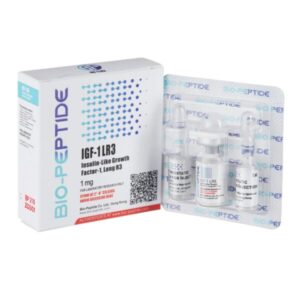
IGF-1 LR3 1 mg by Bio-Peptide
65 EUR250,00 złAdd to cartIn stock
Ships within 24 h
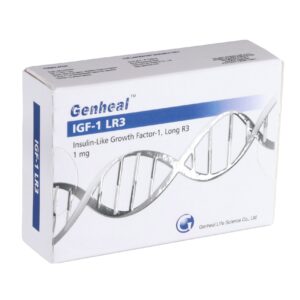
IGF-1 LR3 1 mg by Genheal
65 EUR250,00 złAdd to cartAvailable on backorder
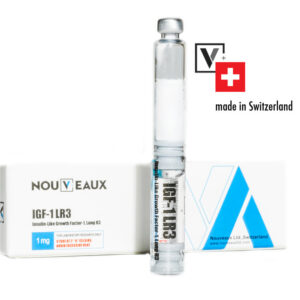
IGF-1 LR3 1 mg by Nouveaux Ltd.
75 EUR300,00 złAdd to cartIn stock
Ships within 24 h
Frequently asked questions
How many mcg of IGF-1 LR3 are in one syringe unit?
With 1 mg in 1 ml, one U-100 syringe unit holds 10 mcg. With 1 mg in 2 ml it holds 5 mcg.
How much water to add to IGF-1 LR3 1 mg?
The kits have 1 or 2 ml of solvent. With 1 ml you get 1000 mcg per millilitre, with 2 ml 500 mcg per millilitre and more precise measuring.
Which IGF-1 LR3 version is the cheapest?
The Bio-Peptide and Genheal versions cost 65 EUR each, and the Nouveaux Ltd. cartridge 75 EUR. Only Bio-Peptide has two solvent ampoules.
How does the Nouveaux cartridge differ from a vial?
The cartridge has the solvent in a second chamber, so it is prepared without transferring liquid. It has one concentration, 10 mcg per syringe unit.
Does IGF-1 LR3 need to be kept in the refrigerator?
The solution after reconstitution does, at 2-8 degrees. The dry powder tolerates short shipping without a refrigerator.
Sources
- Francis GL, Ross M, Ballard FJ et al. Novel recombinant fusion protein analogues of insulin-like growth factor (IGF)-I indicate the relative importance of IGF-binding protein and receptor binding for enhanced biological potency. Journal of Molecular Endocrinology, 1992, 8(3): 213-223. https://pubmed.ncbi.nlm.nih.gov/1378742/
- Tomas FM, Knowles SE, Owens PC et al. Insulin-like growth factor-I (IGF-I) and especially IGF-I variants are anabolic in dexamethasone-treated rats. Biochemical Journal, 1992, 282(1): 91-97. https://pubmed.ncbi.nlm.nih.gov/1371669/