NAD+, 1000 mg. NAD+ is a coenzyme, not a peptide, taking part in energy metabolism, DNA repair and mitochondrial biogenesis, with cellular levels falling with age.
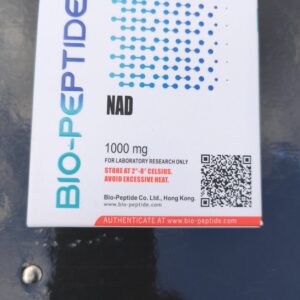
NAD+ (nicotinamide adenine dinucleotide) 1000 mg by Bio-Peptide
75 EUR300,00 złAdd to cartIn stock
What is in this vial
It is the only NAD+ vial in this catalogue. The powder has no concentration of its own: it is set when you add the water. This vial with 5 ml of bacteriostatic water gives 200 mg per millilitre, and with twice that volume, half as much.
The conversion of an amount into insulin syringe units is worked through in the guide on syringe units, and the rules that change once the powder is dissolved are in storage.
Bio-Peptide as the manufacturer
Bio-Peptide has the widest catalogue of the three brands we stock: it is the only one supplying glutathione, NAD+, GHK-Cu, MOTS-C, SLU-PP-332 and semaglutide, so an order from this manufacturer can usually be filled from one supplier. Every vial carries a code under the hologram and a batch certificate, and how to check both is described on the verification page.
What the evidence says
Oral forms have poor bioavailability, so intravenous infusion is the only established route for raising NAD+ clinically. In a six-hour infusion study nothing changed in the first two hours. The full account, with the sources and the limits, is on the NAD+ page, and the background in the guide on NAD and glutathione injections.
We publish no dosing schedules. Sold as research material, not as a medicine.
Concentration in this vial
| Water added | Concentration | Per unit on a U-100 syringe |
|---|---|---|
| 5 ml | 200 mg/ml | 2 mg |
| 10 ml | 100 mg/ml | 1 mg |
| 20 ml | 50 mg/ml | 500 mcg |
The table is arithmetic and nothing else: it converts the 1000 mg in this vial into the concentration you get for a chosen volume of bacteriostatic water. It is not a dosing recommendation, and we publish none.
This vial next to the other NAD+ vials
No other manufacturer here lists NAD+, so this is the only vial of it in the catalogue and there is no brand comparison to make.
Also from Bio-Peptide in this group
Within Skin and longevity, Bio-Peptide also supplies GHK-Cu 100 mg and Glutathione 1000 mg.
What the body needs NAD+ for
NAD+ is a coenzyme of oxidation and reduction reactions. It takes part in glycolysis, the citric acid cycle and oxidative phosphorylation, the three main stages of energy production in the cell. It is also involved in DNA repair and in mitochondrial biogenesis, the formation of new energy-producing organelles.
NAD+ levels in cells fall with age and under metabolic stress. This goes together with weaker mitochondrial function and lower resistance of the cell to strain, and it is the reason for the interest in topping up this coenzyme.
Why the route of administration matters
Oral forms have poor bioavailability, because they are metabolised in the digestive tract before they reach the circulation. That is why intravenous infusion is described as the established way to raise NAD+ levels, and the published human studies concern this route.
All the human studies we found concerned intravenous infusions given under clinical supervision. The ready-made protocols for self-administered subcutaneous injections that circulate in sales copy do not come from clinical trials.
What the human studies showed
| Study | What was found |
|---|---|
| Pilot study with a six-hour infusion | Plasma NAD+ and its metabolites did not change for the first two hours; changes appeared only later |
| Comparative study from 2026, NAD+ against nicotinamide riboside | With NAD+, moderate and severe gastrointestinal complaints, a faster heart rate and chest tightness were reported; with nicotinamide riboside, tingling and minor cramps |
| Infusion time in the same study | 97 minutes on average for NAD+ against 37 minutes for nicotinamide riboside |
| Safety parameters | No meaningful changes in liver enzymes, inflammatory markers, kidney parameters or thyroid function |
The first row is more interesting than it looks. It shows that giving the molecule does not translate at once into a higher plasma level, and that the process is slower than intuition would suggest.
Tolerance, or why the infusion is long
NAD+ infusions are run slowly, and not out of administrative caution. The complaints reported by study participants, including gastrointestinal symptoms and chest tightness, are linked to the rate of administration. That is why in the comparative study an NAD+ infusion took almost two and a half times longer than a nicotinamide riboside infusion.
Who this vial is for
You are interested in energy metabolism and cellular ageing: this is the molecule. You want a large amount in one pack: 1000 mg in a single vial, worked in milligrams rather than micrograms. You are looking for a peptide acting on the hormonal axis: NAD+ is not a peptide and works quite differently.
Does NAD+ really decline with age
The claim that NAD+ levels fall with age is behind all the interest in this molecule. Human studies say two different things here, depending on where it was measured. It is worth knowing both before reading any promise.
| Study | What was measured | Result |
|---|---|---|
| Massudi et al., PLoS One 2012 | skin of 49 people aged 15 to 77 and of newborns | the older the person, the less NAD+ in the skin, clearly in both men and women |
| Clement et al., Rejuvenation Research 2019 | plasma of healthy people aged 20 to 87 | a significant fall in plasma NAD+ with age |
| Trętowicz et al., Nature Metabolism 2026 | whole blood in seven independent groups of people | NAD+ level stable regardless of age and lifestyle changes |
In the skin, the fall in NAD+ came with other changes. The activity of the enzyme PARP, which uses up NAD+ during DNA repair, rose, and DNA damage accumulated. In men, the activity of sirtuin SIRT1, a protein that depends on NAD+, also fell. The authors put this together into one picture: with age the use of NAD+ rises, and its supply in the tissue shrinks.
The 2026 paper does not directly contradict these results, because it measured whole blood, not skin or plasma. What it does show is that a single blood test is not enough to judge NAD+ deficiency. In the same paper, supplementation with nicotinamide riboside changed blood NAD+ levels, so the measurement responds to giving a precursor.
The conclusion for the buyer is simple. A fall in NAD+ with age has been described in tissues, while in whole blood it was not found at all. Descriptions promising rejuvenation from topping up NAD+ go further than what has been measured. Studies of infusions and a comparison with glutathione are gathered in the guide NAD and glutathione injections.
Sources: Massudi et al., PLoS One 2012, Clement et al., Rejuvenation Research 2019, Trętowicz et al., Nature Metabolism 2026.
Questions
How much NAD+ is in this vial?
1000 mg of lyophilised powder from Bio-Peptide, in one vial.
What concentration does 10 ml of water give?
100 mg per millilitre, which is 1 mg per unit on a U-100 insulin syringe. Other volumes are in the table above.
Is NAD+ available from another manufacturer here?
No. Bio-Peptide is the only manufacturer of NAD+ in this catalogue.
Verification and delivery
Every vial carries a code under the hologram and comes from a batch with a certificate of analysis; how to check both is described in check your product. We ship within Poland and abroad. Outside Poland shipping costs 30 EUR paid in advance or 80 EUR cash on delivery, the same for every country: shipping and payments.