Three products sit in this category, and they are three different kinds of molecule: a copper-bound tripeptide, a coenzyme and an antioxidant tripeptide. What links them is the reason people look for them, which is skin and ageing, rather than any shared mechanism.
All three are sold as research material, not as medicines.

NAD+ (nicotinamide adenine dinucleotide) 1000 mg by Bio-Peptide
75 EUR300,00 złAdd to cartIn stock
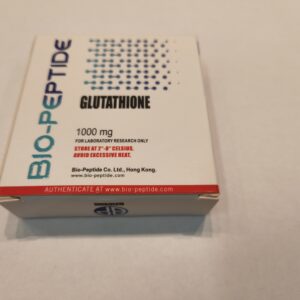
Glutathione 1000 mg by Bio-Peptide
30 EUR120,00 złAdd to cartIn stock

GHK-Cu copper tripeptide 100 mg by Bio-Peptide
40 EUR160,00 złAdd to cartIn stock
What is in this category
| Product | Vial | Manufacturer |
|---|---|---|
| GHK-Cu copper tripeptide | 100 mg | Bio-Peptide |
| NAD+ | 1000 mg | Bio-Peptide |
| Glutathione | 1000 mg | Bio-Peptide |
Prices are on each product page, in euro. Shipping abroad and payment options are on the shipping and payments page.
GHK-Cu: the copper complex, not the tripeptide alone
GHK is a tripeptide of glycine, histidine and lysine. GHK-Cu is its complex with a copper ion. The molecule occurs naturally in the human body, including in plasma, and binds copper with high affinity.
Reviews describe it as increasing collagen and elastin synthesis, the formation of blood vessels and the migration of fibroblasts. One distinction matters more than any of those claims: in a rat wound study, the copper complex increased collagen deposition in a dose-dependent way, while a control tripeptide with a different sequence had no significant effect. It was the copper complex that was tested, not the bare tripeptide.
The same reviews list the limits, and they are worth knowing before you buy. Tripeptides have a half-life below roughly 30 minutes in plasma. Peptide-metal complexes, GHK-Cu among them, are unstable because copper is highly reactive and sensitive to environmental conditions. Skin absorption is poor, because the molecule is strongly hydrophilic, and after intradermal administration roughly 95 percent is cleared quickly.
You will find percentage claims about collagen growth in cosmetic marketing. We do not repeat them, because we could not trace them to a primary publication.
NAD+: a coenzyme sold alongside peptides
NAD+ is not a peptide. It is a coenzyme involved in oxidation and reduction reactions and in energy metabolism: glycolysis, the citric acid cycle and oxidative phosphorylation. It also takes part in DNA repair and mitochondrial biogenesis. Cellular levels fall with age and under metabolic stress.
What human studies show is narrower than the marketing suggests. Oral forms have poor bioavailability because they are metabolised in the digestive tract, which is why intravenous infusion is described as the only established way of raising NAD+ clinically. In a pilot study with a six-hour intravenous infusion, no change in plasma NAD+ or its metabolites appeared during the first two hours.
A comparative study published in 2026 reported that participants receiving intravenous NAD+ had moderate to severe gastrointestinal symptoms, a faster heart rate and chest tightness, while a nicotinamide riboside group had milder symptoms. That study found no significant changes in liver enzymes, inflammatory markers, kidney parameters or thyroid function.
Those studies all concern supervised intravenous infusions. Dosing schedules for self-administered subcutaneous injections, which circulate widely online, do not come from clinical research, and we do not publish them.
Glutathione: purity of the preparation
Glutathione is a tripeptide of cysteine, glycine and glutamic acid, produced naturally in cells. It works as an antioxidant and takes part in detoxification, and its concentration falls with age. None of that is disputed.
The open questions concern injecting it for cosmetic purposes, where data are scarce. A case reported in 2019, with adverse effects after a compounded L-glutathione preparation, was linked to probable high endotoxin levels, that is, to the purity of the preparation. That is why the batch certificate matters with glutathione.
Only one placebo-controlled study has tested intravenous glutathione for skin lightening, and it found no significant difference. There are no dosing or duration guidelines. Risks listed in the literature include toxicity to the liver, kidneys and nervous system, anaphylaxis and Stevens-Johnson syndrome.
Practical notes
All three arrive as lyophilised powder. Concentration follows from how much water you add, and the arithmetic is in reconstituting a peptide. GHK-Cu is among the less stable molecules in solution, so the storage limits in storing peptides matter here more than average.
Frequently asked questions
Is GHK-Cu the same as GHK?
No. GHK-Cu is the copper complex. In a rat wound study the bare tripeptide produced no effect, while the copper complex significantly increased collagen deposition.
Does NAD+ work when taken orally?
Oral forms have poor bioavailability because they are metabolised in the digestive tract. Human studies of raised NAD+ levels used supervised intravenous infusions.
Does injectable glutathione lighten skin?
No clinical trial supports it: the only placebo-controlled study of intravenous glutathione showed no significant difference.
Why is NAD+ sold next to peptides?
Because of how it is used, not what it is. NAD+ is a coenzyme rather than a peptide, and this page says so to avoid the confusion.
Can I order these from outside Poland?
Yes, with shipping at 30 EUR paid in advance or 80 EUR cash on delivery.