GHK-Cu, 100 mg. GHK-Cu is the tripeptide glycine-histidine-lysine complexed with a copper ion, and the copper is what the described activity is attributed to.
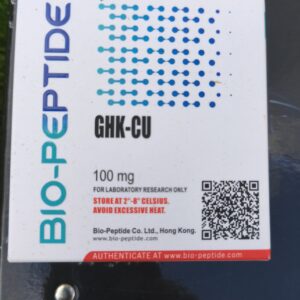
GHK-Cu copper tripeptide 100 mg by Bio-Peptide
40 EUR160,00 złAdd to cartIn stock
What is in this vial
It is the only GHK-Cu vial in this catalogue. The powder has no concentration of its own: it is set when you add the water. This vial with 5 ml of bacteriostatic water gives 20 mg per millilitre, and with twice that volume, half as much.
The conversion of an amount into insulin syringe units is worked through in the guide on syringe units, and the rules that change once the powder is dissolved are in storage.
Bio-Peptide as the manufacturer
Bio-Peptide has the widest catalogue of the three brands we stock: it is the only one supplying glutathione, NAD+, GHK-Cu, MOTS-C, SLU-PP-332 and semaglutide, so an order from this manufacturer can usually be filled from one supplier. Every vial carries a code under the hologram and a batch certificate, and how to check both is described on the verification page.
What the evidence says
Reviews describe increased collagen and elastin synthesis and fibroblast migration. In a rat wound study the copper complex increased collagen deposition, while a control tripeptide had no significant effect. The full account, with the sources and the limits, is on the GHK-Cu page, and the background in the guide on peptides in skincare.
We publish no dosing schedules. Sold as research material, not as a medicine.
Concentration in this vial
| Water added | Concentration | Per unit on a U-100 syringe |
|---|---|---|
| 5 ml | 20 mg/ml | 200 mcg |
| 10 ml | 10 mg/ml | 100 mcg |
| 20 ml | 5 mg/ml | 50 mcg |
The table is arithmetic and nothing else: it converts the 100 mg in this vial into the concentration you get for a chosen volume of bacteriostatic water. It is not a dosing recommendation, and we publish none.
This vial next to the other GHK-Cu vials
No other manufacturer here lists GHK-Cu, so this is the only vial of it in the catalogue and there is no brand comparison to make.
Also from Bio-Peptide in this group
Within Skin and longevity, Bio-Peptide also supplies Glutathione 1000 mg and NAD+ 1000 mg.
A peptide that works through copper
GHK is a tripeptide of glycine, histidine and lysine. On its own it is a small, unremarkable molecule. What sets it apart is a very high affinity for copper ions, with which it forms a stable complex labelled GHK-Cu. The activity described on connective tissue is attributed to that complex, which is why this product is sold as a copper tripeptide and not simply as GHK.
What the research describes
| Area | What was described |
|---|---|
| Connective tissue | Increased synthesis of collagen and elastin |
| Blood vessels | Stimulation of new blood vessel formation |
| Cells | Increased migration of fibroblasts |
| Healing | Faster wound closure in experimental models |
GHK-Cu occurs naturally in the human body, among other places in plasma. Copper is also an element that many enzymes need, including lysyl oxidase, which takes part in building the network of collagen and elastin fibres.
Scientific reviews name four limitations: tripeptides live briefly in the body, under about 30 minutes in plasma; peptide and metal complexes are unstable, because copper is highly reactive and sensitive to its surroundings; the molecule is poorly absorbed through the skin because it is highly hydrophilic; and after intradermal administration it is cleared quickly, with about 95 per cent excreted.
Why stability matters more than usual
For most peptides it is enough to keep the solution in the fridge and away from light; the general rules are in the guide on how to store peptides. GHK-Cu adds a second issue: the copper ion is chemically reactive and the complex can be sensitive to its surroundings. It is worth preparing the solution as you need it, protecting it from light and heat, and not keeping it longer than necessary.
What this description leaves out
We do not quote percentages such as a collagen increase in seven out of ten volunteers, which are easy to find for this molecule. We could not reach the primary publication behind such figures, and copying them from marketing material is exactly the kind of writing we want to avoid. We stay with the mechanism and with the limitations described in scientific reviews.
Who this vial is for
You are interested in connective tissue, collagen and healing rather than the hormonal axis: this is the molecule. You want a large amount in one vial: 100 mg is ten times a typical peptide vial. You are looking for a recovery peptide with a different mechanism: have a look at BPC-157 or TB-500.
GHK-Cu and hair: two placebo-controlled studies in humans
Besides collagen and healing, GHK-Cu has a second area with human data: hair. The mechanism is the same. A hair grows from its follicle, and its growth is controlled by the fibroblasts of the dermal papilla at the base of the follicle. Copper tripeptides stimulate fibroblasts to divide, so that is exactly where researchers tested them.
| Study | Who and for how long | Result |
|---|---|---|
| Lee et al., Annals of Dermatology 2016 | 45 men with male pattern hair loss, 6 months | hair count up by 52.6 and 71.5 in the peptide groups against 9.6 on placebo |
| Bo et al., 2026 | 18 healthy people, serum with 2 percent GHK-Cu on the eyebrows, 12 weeks | more and thicker eyebrow hairs on the peptide side, no change on the other side |
In the 2016 study, participants sprayed the scalp with a lotion every evening, and hairs were counted with a camera always at the same spot. The product combined GHK with 5-aminolevulinic acid, so the share of the peptide alone cannot be separated. No side effects occurred in any group.
The eyebrow study had a simple and strong design. One eyebrow got serum with GHK-Cu, the other the same serum without the peptide, and neither the participants nor the researchers knew which was which. Comparing two eyebrows of the same person rules out many differences between people. There were no serious side effects or allergic reactions.
What the laboratory showed
In 2007, dermatologists in Seoul tested a related copper tripeptide on human hair follicles grown outside the body. The follicles lengthened faster, papilla cells divided faster, and the signals that lead a cell to die fell. In a 1993 study in rats, a copper-binding peptide enlarged follicles in a similar way to topical minoxidil.
Both human studies were small and lasted three to six months. That is more data than most peptides have, but GHK-Cu is not a treatment for hair loss. All the results are described in the guide GHK-Cu: what studies on skin and healing show.
Sources: Lee et al., Annals of Dermatology 2016, Bo et al., Procedia of Multidisciplinary Research 2026, Pyo et al., Archives of Pharmacal Research 2007, Uno and Kurata, Journal of Investigative Dermatology 1993.
Questions
How much GHK-Cu is in this vial?
100 mg of lyophilised powder from Bio-Peptide, in one vial.
What concentration does 10 ml of water give?
10 mg per millilitre, which is 100 mcg per unit on a U-100 insulin syringe. Other volumes are in the table above.
Is GHK-Cu available from another manufacturer here?
No. Bio-Peptide is the only manufacturer of GHK-Cu in this catalogue.
Verification and delivery
Every vial carries a code under the hologram and comes from a batch with a certificate of analysis; how to check both is described in check your product. We ship within Poland and abroad. Outside Poland shipping costs 30 EUR paid in advance or 80 EUR cash on delivery, the same for every country: shipping and payments.