In mouse studies SLU-PP-332 reached the muscles 2 hours after a dose. After 15 days the mice ran about 70 percent longer, and after 28 days obese mice weighed about 12 percent less than the control group. The longest study lasted 8 weeks and looked at the kidneys of old mice. All these numbers come from animal studies, because no human studies have been done yet. Below you will find the full timeline from this work and what the 5 mg vial in the shop contains.
What is SLU-PP-332?
SLU-PP-332 is not a peptide but a small synthetic molecule. It activates three estrogen-related nuclear receptors, ERR alpha, beta and gamma, most strongly ERR alpha. Endurance training activates the same receptors in muscle, which is why the molecule is called an exercise mimetic.
It was developed in the laboratory of Thomas Burris. How SLU-PP-332 differs from exercise is described in SLU-PP-332: exercise in a pill, and everything about the product is on the SLU-PP-332 page.
What happens in the first hours?
The molecule quickly reaches where it acts. In a 2023 study, 2 hours after one dose the SLU-PP-332 level in muscle was about 0.6 micromolar and in plasma about 0.2 micromolar. Muscle therefore held roughly three times more than the blood.
A single dose already switched on a gene programme in mouse muscle that matches acute aerobic exercise. Mitochondrial respiration and fatty acid burning in skeletal muscle rose. This effect depended on the ERR alpha receptor.
What did studies show after 15 days?
After two weeks endurance had changed. In the same 2023 study mice received SLU-PP-332 twice a day for 15 days and then ran on a treadmill until exhausted.
They ran about 70 percent longer and covered about 45 percent more distance than control mice. Their muscles gained oxidative type IIa fibres, the ones that work best during long effort.
What changed after 28 days?
After 4 weeks body weight had changed. In a 2024 study mice made obese by a high-fat diet received SLU-PP-332 twice a day for 28 days.
| Measured after 28 days | SLU-PP-332 | Control group |
|---|---|---|
| body weight | about 12 percent lower | reference point |
| fat gain | under 0.5 g | about 5 g |
| lean mass | unchanged | unchanged |
| food intake | no difference | no difference |
| fasting glucose and insulin | lower | reference point |
| resting energy expenditure | higher | reference point |
The mice lost weight while eating the same amount, and their muscle mass did not change. The glucose tolerance test was also better. In ob/ob mice, obese for genetic reasons, a similar trend appeared after 12 days. The numbers from this study are covered in SLU-PP-332 and body weight.
What did the longest study, 8 weeks, show?
The longest use of SLU-PP-332 was in old mice. In a 2023 study animals aged 21 months received it for 8 weeks. After that time the age-related changes in their kidneys were reversed.
In another study, from 2024, SLU-PP-332 improved ejection fraction in mice with heart failure, reduced scarring of the heart muscle and extended survival. In 2025 an Italian team tested the molecule on muscle cells taken from inactive women. Mitochondrial gene activity rose in them and oxidative stress fell.
What does the whole timeline look like?
| Time | What was measured | Model |
|---|---|---|
| 2 hours | level in muscle about three times higher than in plasma | mice |
| one dose | gene programme like aerobic exercise | mice |
| 12 days | trend to lower weight in ob/ob mice | mice |
| 15 days | running about 70 percent longer, more type IIa fibres | mice |
| 28 days | body weight about 12 percent lower, better glucose | diet-obese mice |
| 8 weeks | age-related kidney changes reversed | mice aged 21 months |
No clinical studies in humans have been done yet, so it is not known how this timeline looks in people. Other metabolic molecules without incretins are compared in MOTS-C, SLU-PP-332 and HGH Fragment 176-191.
What is in the SLU-PP-332 vial?
The shop has one version: SLU-PP-332 5 mg Bio-Peptide for 50 EUR. It is one of the most often bought products in our shop. The kit has a 5 mg vial and two 1 ml solvent ampoules, so you set the concentration yourself.
| Solvent | Concentration | Per 1 U-100 syringe unit |
|---|---|---|
| 1 ml | 5 mg/ml | 50 mcg |
| 2 ml | 2.5 mg/ml | 25 mcg |
This is concentration arithmetic, not a dosing recommendation. How to dissolve the powder is in how to reconstitute peptides, and how to store the solution in how to store peptides. SLU-PP-332 is research material, not a medicine.
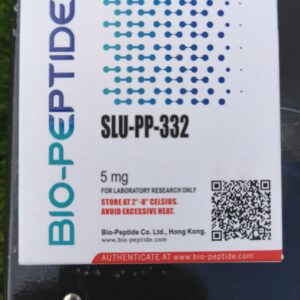
SLU-PP-332 5 mg by Bio-Peptide
50 EUR190,00 złAdd to cartIn stock
Ships within 24 h
Frequently asked questions
How long does SLU-PP-332 take to work?
In mouse studies one dose switched on an exercise-like programme in muscle, after 15 days mice ran about 70 percent longer, and after 28 days obese mice weighed about 12 percent less.
Does SLU-PP-332 reduce body weight?
In diet-obese mice, after 28 days body weight was about 12 percent lower than in the control group, with the same food intake and no loss of lean mass.
Are there human studies of SLU-PP-332?
No. All efficacy data come from mouse studies and cell cultures, including human muscle cells.
Is SLU-PP-332 a peptide?
No. It is a small synthetic molecule that activates the ERR alpha, beta and gamma receptors.
How much does SLU-PP-332 cost in the shop?
The 5 mg Bio-Peptide vial with two solvent ampoules costs 50 EUR.
Sources
- Billon C, Schoepke E, Avdagic A et al. A Synthetic ERR Agonist Alleviates Metabolic Syndrome. Journal of Pharmacology and Experimental Therapeutics, 2024, 388(2): 232-240. https://pubmed.ncbi.nlm.nih.gov/37739806/
- Billon C, Sitaula S, Banerjee S et al. Synthetic ERRalpha/beta/gamma Agonist Induces an ERRalpha-Dependent Acute Aerobic Exercise Response and Enhances Exercise Capacity. ACS Chemical Biology, 2023, 18(4): 756-771. https://pubmed.ncbi.nlm.nih.gov/36988910/
- Wang XX, Myakala K, Libby AE et al. Estrogen-Related Receptor Agonism Reverses Mitochondrial Dysfunction and Inflammation in the Aging Kidney. American Journal of Pathology, 2023, 193(12): 1969-1987. https://pubmed.ncbi.nlm.nih.gov/37717940/
- Xu W, Billon C, Li H et al. Novel Pan-ERR Agonists Ameliorate Heart Failure Through Enhancing Cardiac Fatty Acid Metabolism and Mitochondrial Function. Circulation, 2024, 149(3): 227-250. https://pubmed.ncbi.nlm.nih.gov/37961903/
- Bonanni R, Falvino A, Matticari A et al. Targeting ERRs to counteract age-related muscle atrophy associated with physical inactivity: a pilot study. Frontiers in Physiology, 2025, 16: 1616693. https://pubmed.ncbi.nlm.nih.gov/40692696/