SLU-PP-332, 5 mg. SLU-PP-332 is not a peptide but a synthetic small molecule, a pan-agonist of the estrogen-related receptors, acting most strongly on ERR alpha.
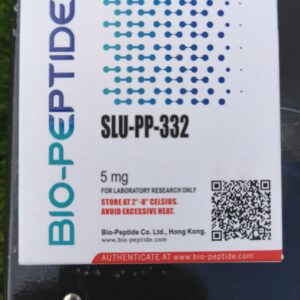
SLU-PP-332 5 mg by Bio-Peptide
50 EUR190,00 złAdd to cartIn stock
What is in this vial
It is the only SLU-PP-332 vial in this catalogue. The powder has no concentration of its own: it is set when you add the water. This vial with 2 ml of bacteriostatic water gives 2.5 mg per millilitre, and with twice that volume, half as much.
The conversion of an amount into insulin syringe units is worked through in the guide on syringe units, and the rules that change once the powder is dissolved are in storage.
Bio-Peptide as the manufacturer
Bio-Peptide has the widest catalogue of the three brands we stock: it is the only one supplying glutathione, NAD+, GHK-Cu, MOTS-C, SLU-PP-332 and semaglutide, so an order from this manufacturer can usually be filled from one supplier. Every vial carries a code under the hologram and a batch certificate, and how to check both is described on the verification page.
What the evidence says
Every efficacy result comes from mice, where a single administration triggered a transcriptional programme resembling aerobic exercise. There have been no clinical trials. The full account, with the sources and the limits, is on the SLU-PP-332 page, and the background in the guide on SLU-PP-332, exercise in a pill.
We publish no dosing schedules. Sold as research material, not as a medicine.
Concentration in this vial
| Water added | Concentration | Per unit on a U-100 syringe |
|---|---|---|
| 1 ml | 5 mg/ml | 50 mcg |
| 2 ml | 2.5 mg/ml | 25 mcg |
| 5 ml | 1 mg/ml | 10 mcg |
The table is arithmetic and nothing else: it converts the 5 mg in this vial into the concentration you get for a chosen volume of bacteriostatic water. It is not a dosing recommendation, and we publish none.
This vial next to the other SLU-PP-332 vials
No other manufacturer here lists SLU-PP-332, so this is the only vial of it in the catalogue and there is no brand comparison to make.
Also from Bio-Peptide in this group
Within Weight loss peptides, Bio-Peptide also supplies MOTS-c 10 mg, Retatrutide 20 mg and Semaglutide 3 mg.
Not a peptide
The distinction is worth making first, because the product sits in a peptide shop. SLU-PP-332 is not a peptide, that is, not a chain of amino acids. It is a synthetic small molecule developed in the laboratory of Thomas Burris. It acts on nuclear receptors, not on the membrane receptors that most peptides in our range use.
ERR receptors and the name exercise mimetic
The molecule is a pan-agonist of the estrogen-related receptors ERR alpha, ERR beta and ERR gamma, acting most strongly on ERR alpha. Pan-agonist means that it stimulates all three subtypes rather than one selected subtype.
The same receptors are switched on by endurance exercise. That is where the term exercise mimetic comes from: the molecule switches on metabolic pathways that training normally switches on, without the mechanical load that comes with real exercise.
What the mouse studies showed
| Area | What was seen in mice |
|---|---|
| Skeletal muscle | Higher mitochondrial respiration and fatty acid oxidation |
| Fibre type | More oxidative type IIa fibres |
| Performance | Better exercise endurance |
| Whole-body metabolism | Higher energy expenditure, less fat mass gain |
| Insulin sensitivity | Improvement in models of metabolic syndrome |
All of these results come from studies in mice. None has yet been repeated in humans, and no clinical trials have been run. It is a preclinical molecule without registration in any country; what that means for research material of this kind is described in the guide on the legal status of peptides.
How it differs from the rest of the range
Peptides such as GHRP-2 or ipamorelin work through membrane receptors in the pituitary and raise hormone release. Incretin molecules such as semaglutide work on GLP-1 receptors. SLU-PP-332 works differently: it enters the cell and acts on receptors that control how genes are read. The intended effect is a change in the metabolic profile of the cell, not a burst of hormone.
Who this vial is for
You are interested in new metabolic molecules and their mechanisms: this is one of the most interesting of recent years. You want a molecule with human data behind it: for this one there are none yet, while the incretins in the same category have large human trials behind them.
Mouse study results in numbers
These are the specific numbers from two papers by the St. Louis team that developed the molecule.
| What was measured | Result in mice |
|---|---|
| Body weight of obese mice after 28 days | about 12 percent lower than without dosing |
| Fat gain over 28 days | under 0.5 g against about 5 g without dosing |
| Amount of food eaten | no difference |
| Lean body mass | no significant change |
| Treadmill running time after 15 days | about 70 percent longer |
| Running distance after 15 days | about 45 percent longer |
| Concentration in muscle 2 hours after dosing | about 3 times higher than in blood |
The most interesting row is the one about food. The mice lost weight even though they ate as much as the animals without dosing. The authors link the drop in weight to higher energy expenditure and fatty acid burning, not to lower appetite. This is how SLU-PP-332 differs from the incretin molecules, which work mainly through satiety.
In the obesity study, mice ate a high-fat diet for 8 weeks. Then for 28 days they received the molecule, still on the same diet. It was given into the abdominal cavity, at a dose calculated per kilogram of the mouse's body weight. Such a dose cannot be transferred directly to humans.
What newer studies brought
After the metabolic work, the molecule was tested in other models. In each of them it improved mitochondrial function.
- Heart: in mice with heart failure it improved ejection fraction, reduced fibrosis and extended survival (Circulation, 2024).
- Kidneys: in 21-month-old mice it reversed age-related changes in the kidneys (American Journal of Pathology, 2023).
- Human muscle cells: in cells taken from inactive women it raised PGC-1 alpha and ERR alpha levels and reduced oxidative stress (Frontiers in Physiology, 2025).
The 2025 paper is the first in which SLU-PP-332 acted on human cells. It is still a laboratory study on cells, not on people. A comparison with two other metabolic molecules in the range is in the guide MOTS-c, SLU-PP-332 and HGH Fragment 176-191.
Sources: Billon et al., Journal of Pharmacology and Experimental Therapeutics 2024, Billon et al., ACS Chemical Biology 2023, Xu et al., Circulation 2024, Wang et al., American Journal of Pathology 2023, Bonanni et al., Frontiers in Physiology 2025.
Questions
How much SLU-PP-332 is in this vial?
5 mg of lyophilised powder from Bio-Peptide, in one vial.
What concentration does 2 ml of water give?
2.5 mg per millilitre, which is 25 mcg per unit on a U-100 insulin syringe. Other volumes are in the table above.
Is SLU-PP-332 available from another manufacturer here?
No. Bio-Peptide is the only manufacturer of SLU-PP-332 in this catalogue.
Verification and delivery
Every vial carries a code under the hologram and comes from a batch with a certificate of analysis; how to check both is described in check your product. We ship within Poland and abroad. Outside Poland shipping costs 30 EUR paid in advance or 80 EUR cash on delivery, the same for every country: shipping and payments.