HGH Fragment 176-191 5 mg reconstituted in 2 ml gives 2500 mcg per millilitre, or 25 mcg per unit of a U-100 insulin syringe. In 1 ml the same vial gives 50 mcg per unit. The Nouveaux Ltd. 10 mg cartridge has a fixed 1 ml and 100 mcg per mark. The finest scale and the lowest price come with the Bio-Peptide vial for 25 EUR, with two ampoules in the kit.
How many mcg of HGH Fragment are in one syringe unit?
| Pack | Liquid | Concentration | Per 1 U-100 unit | Per 10 U-100 units |
|---|---|---|---|---|
| 5 mg vial | 1 ml | 5000 mcg/ml | 50 mcg | 500 mcg |
| 5 mg vial | 2 ml | 2500 mcg/ml | 25 mcg | 250 mcg |
| 10 mg cartridge | 1 ml | 10 000 mcg/ml | 100 mcg | 1000 mcg |
The calculation is simple: a 5 mg vial is 5000 mcg and you divide that number by the millilitres of liquid. A U-100 syringe has 100 units in 1 ml, so one mark is 0.01 ml. These numbers are concentration arithmetic, not a dosing recommendation, and the same calculation for other peptides is in how to convert a peptide amount into insulin syringe units.
The fragment is counted in micrograms, so a fine scale matters a lot here.
How does HGH Fragment 176-191 differ from growth hormone?
HGH Fragment 176-191 is the end section of the growth hormone molecule, amino acids 176 to 191. This section is linked with the effect on fat tissue. The full hormone has 191 amino acids and also acts through IGF-1 on muscles, bones and blood sugar. A detailed comparison of both molecules is in HGH Fragment 176-191 vs growth hormone.
Clinical trials used a close version of this fragment called AOD9604. It is the same section with an extra tyrosine at the start, written as Tyr-hGH 177-191. All the human data described below are based on it.
What did human studies of AOD9604 show?
A 2013 summary covers six placebo-controlled trials and about 900 adults. AOD9604 did not change blood IGF-1 levels, so it did not act like full growth hormone. In the glucose tolerance test it did not worsen sugar metabolism, unlike hGH. No antibodies against the molecule were found in any of the people tested, and tolerance was the same as with placebo. The authors were linked to the company developing AOD9604, and the paper is about safety and does not report the weight loss result.
Earlier data come from animal studies. In obese rats, AOD9604 given for 19 days gave a weight gain of 15.8 g against 35.6 g in the control group, without worse insulin sensitivity. How the fragment compares with other metabolic molecules is covered in MOTS-C, SLU-PP-332 and HGH Fragment 176-191.
5 mg vial or 10 mg cartridge?
| Version | Pack | Per 1 U-100 unit | Price | Per 1 mg |
|---|---|---|---|---|
| HGH Fragment 176-191 5 mg Bio-Peptide | vial and 2 ampoules of 1 ml | 50 or 25 mcg | 25 EUR | 5 EUR |
| HGH Fragment 176-191 10 mg Nouveaux Ltd. | two-chamber cartridge with 1 ml of solvent | 100 mcg | 55 EUR | 5.50 EUR |
A milligram costs almost the same in both versions, so you choose by scale and convenience. The Bio-Peptide vial gives 25 mcg per mark after reconstitution in 2 ml, the most precise measuring in this comparison. The Nouveaux Ltd. cartridge has twice as much substance and ready solvent in a second chamber, so you transfer no liquid, but each mark carries 100 mcg at once. All versions are on the HGH Fragment 176-191 page.
How to reconstitute and store the vial?
- Disinfect the rubber stopper of the vial and the necks of both ampoules.
- Draw 2 ml of solvent from both ampoules, or 1 ml from one, into a syringe.
- Add the liquid slowly down the side of the vial, not straight onto the powder.
- Roll the vial gently between your fingers until the solution is clear, and do not shake it.
- Write the date and concentration on the vial, for example 2500 mcg/ml.
You prepare the cartridge differently: you join both chambers before first use, and the concentration is then always 10 000 mcg per millilitre. Details of both methods are in how to reconstitute peptides.
The dry powder tolerates short shipping without a refrigerator, and after reconstitution you keep the solution in the refrigerator at 2-8 degrees. HGH Fragment has no approved drug label, so we give no use-by time for the solution. Rules for lyophilisate and solution are in how to store peptides, and you can check the authenticity of a vial as described in how to spot genuine peptides.
HGH Fragment is research material, not a medicine. The WADA 2026 list names AOD-9604 and hGH 176-191 in section S2 as growth hormone fragments, banned in sport all year round.
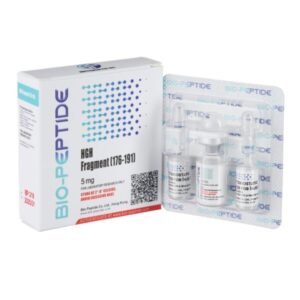
HGH Fragment 176-191 5 mg by Bio-Peptide
25 EUR100,00 złAdd to cartIn stock
Ships within 24 h
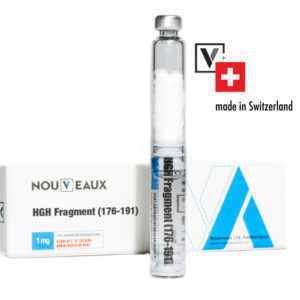
HGH Fragment 176-191 10 mg by Nouveaux Ltd.
55 EUR210,00 złAdd to cartIn stock
Ships within 24 h
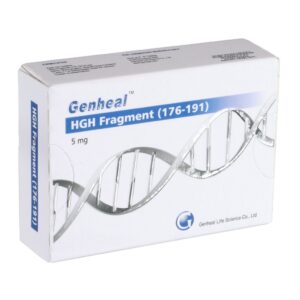
HGH Fragment 176-191 5 mg by Genheal
25 EUR100,00 złAdd to cartIn stock
Ships within 24 h
Frequently asked questions
How many mcg of HGH Fragment are in one syringe unit?
With 5 mg in 2 ml one U-100 syringe unit holds 25 mcg, and with 5 mg in 1 ml 50 mcg. In the 10 mg cartridge with 1 ml it holds 100 mcg.
How much water to add to HGH Fragment 5 mg?
You add 1 or 2 ml, and with 2 ml you get 2500 mcg per millilitre. The Bio-Peptide version comes with two 1 ml ampoules, so you have 2 ml straight away.
Is HGH Fragment 176-191 the same as AOD9604?
Almost, because AOD9604 is the same end section of growth hormone with an extra tyrosine at the start. Human studies were done with AOD9604.
Does HGH Fragment raise IGF-1?
In six placebo-controlled trials AOD9604 did not change blood IGF-1 levels. That is how it differs from full growth hormone, which raises IGF-1.
Which HGH Fragment pack is cheaper?
The Bio-Peptide 5 mg vial costs 25 EUR, or 5 EUR per milligram, and the Nouveaux Ltd. 10 mg cartridge 55 EUR, or 5.50 EUR per milligram. For a start the vial is cheaper.
Sources
- Stier H, Vos E, Kenley D. Safety and Tolerability of the Hexadecapeptide AOD9604 in Humans. Journal of Endocrinology and Metabolism, 2013, 3(1-2): 7-15. https://jofem.org/index.php/jofem/article/view/157
- Ng FM, Sun J, Sharma L, Libinaka R, Jiang WJ, Gianello R. Metabolic studies of a synthetic lipolytic domain (AOD9604) of human growth hormone. Hormone Research, 2000, 53(6): 274-278. https://pubmed.ncbi.nlm.nih.gov/11146367/
- Heffernan MA, Thorburn AW, Fam B, Summers R, Conway-Campbell B, Waters MJ, Ng FM. Increase of fat oxidation and weight loss in obese mice caused by chronic treatment with human growth hormone or a modified C-terminal fragment. International Journal of Obesity and Related Metabolic Disorders, 2001, 25(10): 1442-1449. https://pubmed.ncbi.nlm.nih.gov/11673763/