
PEG-MGF, 5 mg. PEG-MGF is mechano growth factor with polyethylene glycol attached, a construct that does not occur in the body and that clears far more slowly than unmodified MGF.
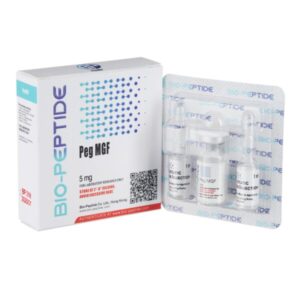
PEG-MGF 5 mg by Bio-Peptide
30 EUR120,00 złAdd to cartIn stock
What is in this vial
It is the smaller of the PEG-MGF vials sold here, which means less substance standing in solution at a time. The powder has no concentration of its own: it is set when you add the water. This vial with 2 ml of bacteriostatic water gives 2.5 mg per millilitre, and with twice that volume, half as much.
The conversion of an amount into insulin syringe units is worked through in the guide on syringe units, and the rules that change once the powder is dissolved are in storage.
Bio-Peptide as the manufacturer
Bio-Peptide has the widest catalogue of the three brands we stock: it is the only one supplying glutathione, NAD+, GHK-Cu, MOTS-C, SLU-PP-332 and semaglutide, so an order from this manufacturer can usually be filled from one supplier. Every vial carries a code under the hologram and a batch certificate, and how to check both is described on the verification page.
What the evidence says
Pegylation is a pharmacokinetic argument, not evidence of an effect. No completed randomised trial of administering either form had been published as of April 2026. The full account, with the sources and the limits, is on the PEG-MGF page, and the background in the guide on MGF and PEG-MGF.
We publish no dosing schedules. Sold as research material, not as a medicine.
Bio-Peptide is one of the two brands here that fill both MGF and its pegylated form, so the comparison between minutes and days of action can be made without changing producer. This vial is the pegylated one, in 5 mg.
Concentration in this vial
| Water added | Concentration | Per unit on a U-100 syringe |
|---|---|---|
| 1 ml | 5 mg/ml | 50 mcg |
| 2 ml | 2.5 mg/ml | 25 mcg |
| 5 ml | 1 mg/ml | 10 mcg |
The table is arithmetic and nothing else: it converts the 5 mg in this vial into the concentration you get for a chosen volume of bacteriostatic water. It is not a dosing recommendation, and we publish none.
This vial next to the other PEG-MGF vials
The same compound is sold here in two other versions: Genheal, 5 mg and Nouveaux Ltd., 10 mg. The molecule is identical in each; what differs is the manufacturer and the amount in the vial. This is the smallest of the 3, so less substance stands in solution at a time.
Also from Bio-Peptide in this group
Within Muscle peptides, Bio-Peptide also supplies ACE-031 10 mg, DES(1-3) IGF-1 1 mg and Follistatin 344 1 mg.
What pegylation does
Polyethylene glycol, PEG for short, is a chemically inert polymer attached to drug molecules and peptides. It makes the molecule larger and slows its removal from the circulation. It has no biological action of its own and does not change what the peptide binds to.
The effect is purely pharmacokinetic: the same molecule stays available for longer. With MGF, whose natural form breaks down in body fluids within minutes, that difference decides whether working with the peptide is practical at all. The extension potentially reaches days and depends on the size of the attached PEG molecule.
An important distinction: PEG-MGF does not occur in the body. Natural MGF is made from the IGF-1 gene under mechanical load, while the pegylated version is a construct made in a laboratory.
What the data show and what they do not
Human data are limited to observational studies measuring the body's own MGF expression after exercise, which is something quite different from the effect of giving the peptide from outside. One independent laboratory also found no proliferative effect on primary human myoblasts. Claims of a local action on damaged muscle fibres, easy to find in sales copy, have no support in these data.
Two concentrations with a 5 mg vial
The Bio-Peptide box holds two solvent ampoules.
| Dissolved in | Concentration | Syringe unit | When it suits |
|---|---|---|---|
| 1 ml | 5000 mcg per ml | 50 mcg | Less liquid, simpler arithmetic |
| 2 ml | 2500 mcg per ml | 25 mcg | Fine scale for small portions |
The vial holds 5 mg, half of a typical peptide pack, so the ratios come out lower than with 10 mg vials. Check them before the first draw rather than carrying over a habit from another product.
Who this vial is for
The short life of plain MGF puts you off: pegylation answers exactly that problem. You measure small portions and want a fine scale: two ampoules give 25 mcg per unit. You would rather have the molecule without pegylation: take MGF. You want a bigger pack: there is PEG-MGF 10 mg from Nouveaux Ltd.
The two papers the whole MGF story rests on
MGF is one of the forms in which the body reads the IGF-1 gene. The IGF-1Ea form is made mainly in the liver and acts throughout the body. The IGF-1Ec form is made in muscle after loading, and this is the one called mechano growth factor. Its end fragment E is about 24 amino acids long, and it is this fragment that is in the vial, in pegylated form.
| Paper | What was tested | Result |
|---|---|---|
| Yang and Goldspink, FEBS Letters 2002 | fragment E and mature IGF-1 in myoblast culture | fragment E increased cell proliferation and held back differentiation, which mature IGF-1 did not |
| Fornaro et al., American Journal of Physiology 2014 | MGF up to 500 ng/ml on mouse and human cells | no effect on proliferation or differentiation, including in primary human myoblasts |
The first paper started the whole theory. Blocking the IGF-1 receptor with an antibody suggested that fragment E acts through a different receptor. That is where the idea of a local repair factor, independent of IGF-1 in the whole body, came from.
The second paper, from an independent laboratory, tested this more broadly. Mature IGF-1 and the full IGF-1Eb form stimulated proliferation in all cell types. MGF did so in none of them. In heart cells, neither ordinary nor stabilised MGF triggered the signal that IGF-1 produced. The authors questioned whether MGF plays a separate role in the body at all.
Both papers concern cells in the laboratory, not giving the peptide to people. The whole story is described in the guide MGF and PEG-MGF: mechano growth factor and pegylation.
Sources: Yang and Goldspink, FEBS Letters 2002, Fornaro et al., American Journal of Physiology 2014.
Questions
How much PEG-MGF is in this vial?
5 mg of lyophilised powder from Bio-Peptide, in one vial.
What concentration does 2 ml of water give?
2.5 mg per millilitre, which is 25 mcg per unit on a U-100 insulin syringe. Other volumes are in the table above.
Is this the same molecule as the Genheal vial?
Yes. PEG-MGF is the same compound in every vial here, and both hold 5 mg. What differs is the manufacturer and the batch certificate that comes with it.
Verification and delivery
Every vial carries a code under the hologram and comes from a batch with a certificate of analysis; how to check both is described in check your product. We ship within Poland and abroad. Outside Poland shipping costs 30 EUR paid in advance or 80 EUR cash on delivery, the same for every country: shipping and payments.