In studies in rats, thymosin beta-4, from which TB-500 is derived, sped up wound healing after just 4 days. The skin surface then regrew 42 percent faster than in the control group, and after 7 days up to 61 percent faster. In cell culture, the movement of skin cells sped up after 4 to 5 hours. In humans, full thymosin beta-4 was studied as eye drops for 28 days and topically on leg ulcers for 3 months. Below you will find the whole timeline from these studies and what of it applies to TB-500 itself.
What is TB-500?
TB-500 is a short synthetic fragment of thymosin beta-4, a protein of 43 amino acids. It covers the part of the molecule that binds actin, described by the sequence Ac-LKKTETQ. Actin is the protein that forms the skeleton of a cell and lets it move. Thymosin beta-4 is present in almost every cell of our body.
How TB-500 differs from the other regeneration peptide is explained in TB-500 vs BPC-157. All versions in the shop are on the TB-500 page.
Do results for thymosin beta-4 apply to TB-500?
Partly, and one 2003 study explains why. The Philp team compared full thymosin beta-4 with its fragments and with synthetic peptides. The seven amino acid actin-binding fragment proved essential for forming new blood vessels.
In tests on human endothelial cells and on chick embryo vessels, the full molecule and the fragment alone acted almost identically, at a concentration of about 50 nM. Peptides without the actin-binding fragment did not act at all. TB-500 contains exactly this fragment, which is why studies of full thymosin beta-4 are its closest reference point.
After how many hours does it act in cell culture?
In cell culture the first effect appeared within a few hours. In a 1999 study thymosin beta-4 sped up the migration of keratinocytes, the cells of the skin surface. After 4 to 5 hours the cells moved 2 to 3 times faster than in culture medium alone.
As little as 10 picograms of thymosin beta-4 was enough for this effect. Cell movement is the first step of healing, because cells have to reach the damaged site.
What did studies show after 4 and 7 days?
The most detailed timeline comes from the same study in rats with full-thickness skin wounds. Thymosin beta-4 was applied to the wound or given into the abdominal cavity.
| Time after wounding | What was measured | Result compared with saline |
|---|---|---|
| 4 days | regrowth of the skin surface | 42 percent faster |
| 7 days | regrowth of the skin surface | up to 61 percent faster |
| 7 days | wound contraction | at least 11 percent greater |
| 7 days | collagen and new vessels in the wound | more than in controls |
Thymosin worked both when applied to the wound and when given systemically, into the abdominal cavity. The authors called it a potent healing factor with multiple actions.
What did studies in humans show?
In humans full thymosin beta-4 was studied, not the fragment alone. The shortest efficacy study lasted 28 days and the longest 3 months.
| Study | Who and how | Duration | Result |
|---|---|---|---|
| Ruff 2010 | 40 healthy volunteers, intravenous, doses of 42-1260 mg | 14 days, daily | well tolerated, no dose-limiting toxicity |
| Sosne 2015 | 72 people with dry eye, 0.1 percent drops | 28 days | discomfort in the challenge test 27 percent lower, less corneal damage, no adverse events |
| Guarnera 2010 | 73 patients with venous leg ulcers, topical, 8 centres in Italy and Poland | 3 months | complete healing in about 25 percent of patients at 0.03 percent |
In the eye drop study the two primary endpoints did not differ from placebo. Significant differences appeared in several secondary endpoints, including discomfort on day 28. In the ulcer study small and moderate wounds healed best.
How long does TB-500 stay in the body?
No human pharmacokinetic studies have been published for the TB-500 fragment itself, so we give no number. For full thymosin beta-4 given intravenously, the 2010 Ruff study showed that the half-life grew longer as the dose rose.
Half-life describes how a substance disappears from the blood, not how long it acts. The difference is explained in how long peptides stay in the body.
What does the whole timeline look like?
| Time | What happened | Model |
|---|---|---|
| 4-5 hours | skin cells move 2-3 times faster | cell culture |
| 4 days | skin surface regrows 42 percent faster | rats |
| 7 days | skin surface 61 percent faster, wound contracted 11 percent more | rats |
| 14 days | daily intravenous use well tolerated | healthy volunteers |
| 28 days | eye discomfort 27 percent lower | humans, eye drops |
| 3 months | complete ulcer healing in about 25 percent of patients | humans, topical |
Which TB-500 version to choose?
All three versions contain 10 mg of lyophilisate and differ in pack and price.
| Product | Solvent | Price |
|---|---|---|
| TB-500 10 mg Genheal | 1 ampoule | 35 EUR |
| TB-500 10 mg Bio-Peptide | 2 ampoules of 1 ml | 35 EUR |
| TB-500 10 mg Nouveaux Ltd. | 1 ml in the second chamber of the cartridge | 45 EUR |
| BPC-157 and TB-500 MIX Genheal | both peptides in one vial | 35 EUR |
After dissolving 10 mg in 1 ml, one U-100 syringe unit holds 100 mcg, and in 2 ml 50 mcg. This is concentration arithmetic, not a dosing recommendation. Why TB-500 is combined with BPC-157 is explained in BPC-157 and TB-500 together. Results of BPC-157 in muscle injury are in BPC-157 and muscle injury.
TB-500 is not an approved medicine and is sold as research material. It is banned in sport all year round, as described in BPC-157, TB-500 and the WADA ban.
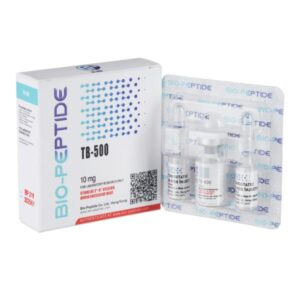
TB-500 10 mg by Bio-Peptide
35 EUR140,00 złAdd to cartIn stock
Ships within 24 h
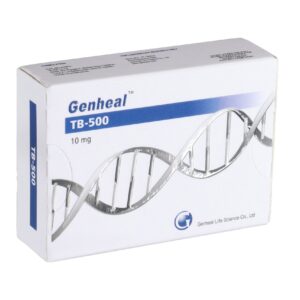
TB-500 10 mg by Genheal
35 EUR135,00 złAdd to cartIn stock
Ships within 24 h
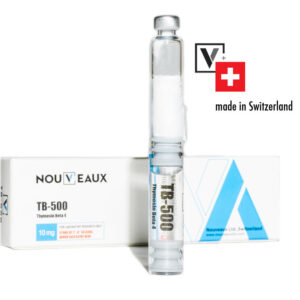
TB-500 10 mg by Nouveaux Ltd.
45 EUR180,00 złAdd to cartIn stock
Ships within 24 h
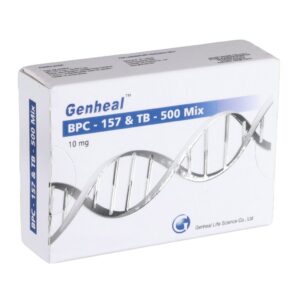
BPC-157 & TB-500 MIX 10 mg by Genheal
35 EUR130,00 złAdd to cartIn stock
Ships within 24 h
Frequently asked questions
How long does TB-500 take to work?
In studies in rats, thymosin beta-4, from which TB-500 is derived, sped up regrowth of the skin surface by 42 percent after 4 days and by up to 61 percent after 7 days. In cell culture cell movement sped up after 4 to 5 hours.
Is TB-500 the same as thymosin beta-4?
No. TB-500 is a short fragment of thymosin beta-4 that covers the actin-binding site. In a 2003 study this fragment acted on vessel formation almost exactly like the full molecule.
Are there studies of TB-500 in humans?
In humans full thymosin beta-4 was studied: intravenously for 14 days in healthy volunteers, as eye drops for 28 days and topically on ulcers for 3 months. No human efficacy studies of the fragment itself have been published.
How long does TB-500 stay in the body?
There are no human pharmacokinetic studies for the TB-500 fragment. For full thymosin beta-4 the half-life grew longer as the dose rose.
How much does TB-500 cost in the shop?
The 10 mg vials by Genheal and Bio-Peptide cost 35 EUR each, and the Nouveaux Ltd. cartridge costs 45 EUR. The mix with BPC-157 costs 35 EUR.
Sources
- Malinda KM, Sidhu GS, Mani H et al. Thymosin beta4 accelerates wound healing. Journal of Investigative Dermatology, 1999, 113(3): 364-368. https://pubmed.ncbi.nlm.nih.gov/10469335/
- Philp D, Huff T, Gho YS, Hannappel E, Kleinman HK. The actin binding site on thymosin beta4 promotes angiogenesis. FASEB Journal, 2003, 17(14): 2103-2105. https://pubmed.ncbi.nlm.nih.gov/14500546/
- Ruff D, Crockford D, Girardi G, Zhang Y. A randomized, placebo-controlled, single and multiple dose study of intravenous thymosin beta4 in healthy volunteers. Annals of the New York Academy of Sciences, 2010, 1194: 223-229. https://pubmed.ncbi.nlm.nih.gov/20536472/
- Sosne G, Ousler GW. Thymosin beta 4 ophthalmic solution for dry eye: a randomized, placebo-controlled, Phase II clinical trial conducted using the controlled adverse environment (CAE) model. Clinical Ophthalmology, 2015, 9: 877-884. https://pubmed.ncbi.nlm.nih.gov/26056426/
- Guarnera G, DeRosa A, Camerini R. The effect of thymosin treatment of venous ulcers. Annals of the New York Academy of Sciences, 2010, 1194: 207-212. https://pubmed.ncbi.nlm.nih.gov/20536470/