BPC-157 and TB-500 blend, 10 mg. One vial holding both BPC-157 and TB-500 as lyophilised powder, bought for convenience rather than for a demonstrated advantage.
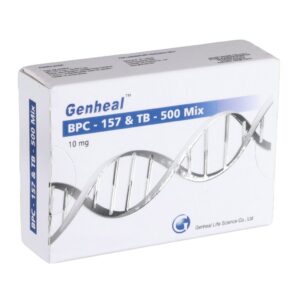
BPC-157 & TB-500 MIX 10 mg by Genheal
35 EUR130,00 złAdd to cartIn stock
What is in this vial
It is the only BPC-157 and TB-500 blend vial in this catalogue. The powder has no concentration of its own: it is set when you add the water. This vial with 2 ml of bacteriostatic water gives 5 mg per millilitre, and with twice that volume, half as much.
The conversion of an amount into insulin syringe units is worked through in the guide on syringe units, and the rules that change once the powder is dissolved are in storage.
Genheal as the manufacturer
Genheal covers the growth hormone axis more completely than the other two brands and is the only one here supplying the BPC-157 and TB-500 blend and tesamorelin. Its vials carry a code under the hologram and a batch certificate, checked the same way as any other brand in this shop.
What the evidence says
No randomised or controlled trial has tested the pair in humans. The only human data in which both appear is a retrospective knee study in sixteen people. The full account, with the sources and the limits, is on the BPC-157 and TB-500 blend page, and the background in the guide on BPC-157 and TB-500 together.
We publish no dosing schedules. Sold as research material, not as a medicine.
Concentration in this vial
| Water added | Concentration | Per unit on a U-100 syringe |
|---|---|---|
| 1 ml | 10 mg/ml | 100 mcg |
| 2 ml | 5 mg/ml | 50 mcg |
| 5 ml | 2 mg/ml | 20 mcg |
The table is arithmetic and nothing else: it converts the 10 mg in this vial into the concentration you get for a chosen volume of bacteriostatic water. It is not a dosing recommendation, and we publish none.
This vial next to the other BPC-157 and TB-500 blend vials
No other manufacturer here lists BPC-157 and TB-500 blend, so this is the only vial of it in the catalogue and there is no brand comparison to make.
Also from Genheal in this group
Within Recovery peptides, Genheal also supplies BPC-157 5 mg and TB-500 10 mg.
Why these two peptides are put together
The reason is simple: both are described as recovery peptides, and their mechanisms differ. BPC-157 is a peptide of 15 amino acids corresponding to a fragment of a protein from gastric juice, and it is described mainly as acting locally. TB-500 is a fragment of thymosin beta-4, a protein present in many tissues, and it is studied for a systemic action.
So they are combined not because they do the same thing more strongly, but because they aim at different things. That reasoning rests on the mechanisms, not on a study comparing the blend with the single peptides. No such study exists, and we do not claim that the blend was developed clinically, that it treats injuries or that the two peptides reinforce each other.
What is known about each peptide
| BPC-157 | TB-500 | |
|---|---|---|
| Animal data | Healing of tendons, muscle and the gastric lining in rats | Effects on cell migration and blood vessel formation |
| Human data | One small observational study in 16 people | No completed efficacy studies for the fragment itself |
| Randomised trials | None | None |
| Status in sport | Prohibited at all times | Prohibited at all times, category S2 |
The level of evidence for both is rated as low. You are buying research material with a described mechanism, not a product with proven effectiveness, and we prefer to say so plainly. The differences between the two molecules are set out in the guide on TB-500 versus BPC-157.
Blend or two separate vials
| Ready blend | Two separate vials | |
|---|---|---|
| Ratio | Set by the manufacturer | You set it yourself each time |
| Preparation | One reconstitution | Two reconstitutions and two conversions |
| Flexibility | You change all or nothing | You change one component without the other |
| Cost | Lower than two packs | Higher, with full control |
Preparation and storage
Wipe the rubber stopper with an alcohol swab and wait a moment. Add the solvent slowly down the inside wall of the vial, not straight onto the powder. Leave the vial for a few minutes, without shaking. Keep the finished solution in the fridge at 2 to 8 degrees Celsius, away from light. The step-by-step guide is how to reconstitute peptides.
Who this vial is for
You want both peptides at once, simply and for less than two packs: this is the vial. You care about controlling the ratio: buy BPC-157 and TB-500 separately. You are interested only in a local action: BPC-157 alone is enough. You are looking for a systemic action: take TB-500 alone.
The only study in which both peptides were given together
The combination of BPC-157 with thymosin beta-4, the protein TB-500 comes from, appeared in one human study. It was published in 2021 in Alternative Therapies in Health and Medicine. It was a review of the records of knee pain patients from one clinic in Florida. The patients received an injection into the joint, either BPC-157 alone or BPC-157 together with thymosin beta-4.
| Group | Number of people | Clear improvement in pain |
|---|---|---|
| BPC-157 alone | 12 | 11 people |
| BPC-157 with thymosin beta-4 | 4 | 3 people |
| Total | 16 | 14 people, or 87.5 percent |
The injection usually took place six months to a year before the telephone interview with the patient. A 2025 systematic review reports that in 7 of the 12 people on BPC-157 alone the relief lasted more than six months. The study had no comparison group, and the combination group had four people. So it cannot tell whether the combination works better than BPC-157 alone.
Ligaments in rats and the first safety data
The closest to the knee is a study of the medial collateral ligament in rats, published in 2010 in the Journal of Orthopaedic Research. The ligament was cut and healing was followed for 90 days. With each of the three routes of giving BPC-157, the ligament healed better in function, strength and tissue structure.
In a 2025 pilot, two people received BPC-157 intravenously on two consecutive days. Markers of heart, liver, kidney and thyroid function and blood sugar did not change. Two people are a very small group, though, and there are no large human safety studies. A 2025 review rated all knowledge on BPC-157 in orthopaedics as level IV and V evidence, the lower end of the scale: of 36 papers, 35 were preclinical studies. More on joints in the guide BPC-157 for joints and the knee.
Sources: Lee and Padgett, Alternative Therapies in Health and Medicine 2021, Vasireddi et al., HSS Journal 2025, Cerovecki et al., Journal of Orthopaedic Research 2010, Lee and Burgess, Alternative Therapies in Health and Medicine 2025.
Questions
How much BPC-157 and TB-500 blend is in this vial?
10 mg of lyophilised powder from Genheal, in one vial.
What concentration does 2 ml of water give?
5 mg per millilitre, which is 50 mcg per unit on a U-100 insulin syringe. Other volumes are in the table above.
Is BPC-157 and TB-500 blend available from another manufacturer here?
No. Genheal is the only manufacturer of BPC-157 and TB-500 blend in this catalogue.
Verification and delivery
Every vial carries a code under the hologram and comes from a batch with a certificate of analysis; how to check both is described in check your product. We ship within Poland and abroad. Outside Poland shipping costs 30 EUR paid in advance or 80 EUR cash on delivery, the same for every country: shipping and payments.