BPC-157, 20 mg. BPC-157 is a synthetic fifteen amino acid peptide based on a fragment of a protein found in human gastric juice, and the most widely bought recovery peptide in this shop.
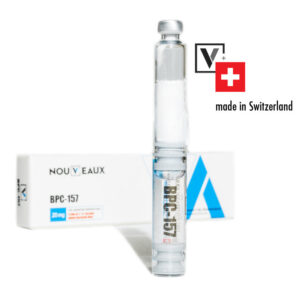
BPC-157 20 mg by Nouveaux Ltd.
65 EUR260,00 złAdd to cartIn stock
What is in the pack
It is the largest BPC-157 pack in this catalogue, which makes it the cheapest per milligram and also the one that stands longest in solution once opened. Nouveaux Ltd. supplies this product as a dual-chamber cartridge: 20 mg of freeze-dried powder in one chamber and 1 ml of solvent in the other. The chambers are joined just before first use, so no liquid has to be moved from one container to another. After activation with the included millilitre the solution stands at 20 mg per millilitre, which is 200 mcg per unit on a U-100 syringe.
The conversion of an amount into insulin syringe units is worked through in the guide on syringe units, and the rules that change once the powder is dissolved are in storage.
Nouveaux Ltd. as the manufacturer
Nouveaux Ltd. has the narrowest catalogue of the three and the largest packs: BPC-157 20 mg, CJC-1295 10 mg, sermorelin 10 mg, PEG-MGF 10 mg and follistatin 2 mg are all exclusive to this brand here. A larger pack costs less per milligram, and it also stands longer once dissolved, which is the trade-off to weigh before ordering.
What the evidence says
The strong evidence is from animals: healing of tendon, muscle and ligament injuries and protection of the gastric lining. The human evidence is one small observational study in sixteen people. The full account, with the sources and the limits, is on the BPC-157 page, and the background in the guide on what the research on BPC-157 shows.
We publish no dosing schedules. Sold as research material, not as a medicine.
This is the only 20 mg BPC-157 pack in the catalogue and the largest single pack Nouveaux Ltd. supplies here. Four times the content of a 5 mg vial means a lower cost per milligram and a solution that has to stand four times as long, which is the trade-off worth settling before you order rather than after.
Concentration in this cartridge
| Total liquid | Concentration | Per unit on a U-100 syringe |
|---|---|---|
| 1 ml | 20 mg/ml | 200 mcg |
| 2 ml | 10 mg/ml | 100 mcg |
| 5 ml | 4 mg/ml | 40 mcg |
The table is arithmetic and nothing else: it converts the 20 mg in this cartridge into the concentration for a given total volume of liquid. The 1 ml row is the cartridge as supplied, after the chambers are joined; the other rows show what further dilution would give. It is not a dosing recommendation, and we publish none.
This cartridge next to the BPC-157 vials
The same compound is sold here in two other versions: Bio-Peptide, 5 mg and Genheal, 5 mg. The molecule is identical in each; what differs is the manufacturer and the amount in the pack. This is the largest of the 3 packs, which makes it the cheapest per milligram and the one that stands longest in solution.
Also from Nouveaux Ltd. in this group
Within Recovery peptides, Nouveaux Ltd. also supplies TB-500 10 mg.
TB-500 and BPC-157 are two different molecules
These two peptides end up in the same basket so often that it is easy to treat them as variants of one thing. They are not. TB-500 is a synthetic fragment of thymosin beta-4, a protein of 43 amino acids present in many tissues. BPC-157 is a standalone peptide of 15 amino acids, based on a protein found in gastric juice.
| Feature | TB-500 | BPC-157 |
|---|---|---|
| Origin | Fragment of thymosin beta-4 | Fragment of a protein from gastric juice |
| Structure | Short section of a larger protein | Standalone peptide of 15 amino acids |
| Described action | Studied as systemic | Described mainly as local |
| Human data | No completed efficacy studies for the fragment | One small observational study |
| Status in sport | Prohibited at all times, category S2 | Prohibited at all times |
The full comparison with sources is in the guide on TB-500 versus BPC-157.
What BPC-157 is
BPC-157 is a pentadecapeptide, a chain of 15 amino acids, based on a partial sequence of a protective compound first isolated from human gastric juice. In the stomach that compound is linked to protecting tissue against an acidic environment and to repairing the lining. That origin explains why the peptide is studied in the context of stomach ulcers and gut inflammation, and more widely for the healing of tendons, ligaments and the gastric mucosa.
What the animal studies describe
The mechanism most often described is angiogenesis, the formation of new blood vessels from existing ones. Damaged tissue after an injury is often poorly supplied with blood, and new vessels are meant to bring oxygen and nutrients to it. A second line of research concerns protection of the endothelium, the layer of cells lining the blood vessels, and the regulation of blood flow in the digestive tract. In animal studies BPC-157 also protected the lining of the stomach and intestines against damage caused by non-steroidal anti-inflammatory drugs.
All of this comes from animals. There are no randomised trials of BPC-157 in humans; the clinical data come down to one small observational study, so there is no answer to how quickly or how strongly anything works in a person.
The cartridge in practice
The Nouveaux Ltd. pack is a dual-chamber cartridge: 20 mg of powder in one chamber and 1 ml of solvent in the other. The chambers are joined just before first use, so nothing has to be transferred between containers. After activation the solution stands at 20 mg per millilitre, which is 20,000 mcg per millilitre or 200 mcg per unit on a U-100 syringe, four times the concentration of a 5 mg vial dissolved in the same volume. At that strength a mistake of one mark on the syringe changes the amount by 200 mcg. Keep the activated cartridge in the fridge at 2 to 8 degrees Celsius; left in the sun or at room temperature for days, the peptide loses its structure.
Who this cartridge is for
You plan longer work with BPC-157 and want the largest content in the catalogue, restocked less often: this is the pack. You want a finer scale and a weaker solution: the Bio-Peptide box holds 5 mg with two ampoules. You want BPC-157 together with TB-500 in one vial: there is a ready blend of both.
The Achilles tendon: what a 2026 study showed
The newest study of BPC-157 and tendon appeared in 2026 in Joint Diseases and Related Surgery. Researchers cut and sutured the Achilles tendon in 32 rats. The animals were randomly split into four groups of 8: control, BPC-157, TB-500 and both peptides. Treatment lasted 4 weeks.
| What was measured | Result |
|---|---|
| Maximum load to failure | higher with BPC-157 and with TB-500, significantly only with TB-500 |
| Tendon structure score under the microscope | significantly better with TB-500 and with the combination; better with BPC-157 alone, but not significantly |
| Combination of both peptides | no extra benefit over either alone |
This study is worth knowing because it is one of the few in which BPC-157 was compared with another peptide in the same protocol. The direction was favourable for both, but with eight animals per group only the TB-500 result crossed the threshold of statistical significance.
What happens in tendon cells
A 2014 paper in Molecules examined fibroblasts, the cells that build tendon, taken from the rat Achilles tendon. BPC-157 increased the number of growth hormone receptors in them, depending on dose and time. When growth hormone was added, cells with BPC-157 multiplied faster. This is one of the proposed mechanisms of its effect on tendon.
A 2026 review in Pharmaceuticals sums up the rat studies as consistently favourable for tendons, ligaments and muscles, across different routes of administration. There are no efficacy studies in humans for tendons. This cartridge holds 20 mg, which gives the lowest price per milligram of BPC-157 in the shop: 3.25 EUR, against 4 EUR in the 5 mg vials. This is described in the guide BPC-157 5 mg or 20 mg.
Sources: Biçer et al., Joint Diseases and Related Surgery 2026, Chang et al., Molecules 2014, Matek et al., Pharmaceuticals 2026.
Questions
How much BPC-157 is in this cartridge?
20 mg of lyophilised powder from Nouveaux Ltd., in a dual-chamber cartridge with 1 ml of solvent.
What concentration does the included millilitre give?
20 mg per millilitre, which is 200 mcg per unit on a U-100 insulin syringe. Other volumes are in the table above.
Is this the same molecule as the Bio-Peptide vial?
Yes. BPC-157 is the same compound in every pack here. The difference is the manufacturer and the amount: 20 mg in this one against 5 mg in that one.
Verification and delivery
Every pack carries a code under the hologram and comes from a batch with a certificate of analysis; how to check both is described in check your product. We ship within Poland and abroad. Outside Poland shipping costs 30 EUR paid in advance or 80 EUR cash on delivery, the same for every country: shipping and payments.