BPC-157, 5 mg. BPC-157 is a synthetic fifteen amino acid peptide based on a fragment of a protein found in human gastric juice, and the most widely bought recovery peptide in this shop.
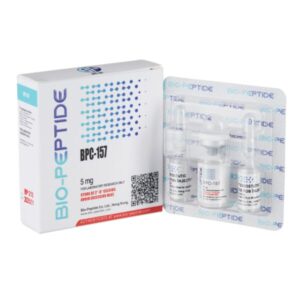
BPC-157 5 mg by Bio-Peptide
20 EUR75,00 złAdd to cartIn stock
What is in this vial
It is the smaller of the BPC-157 vials sold here, which means less substance standing in solution at a time. The powder has no concentration of its own: it is set when you add the water. This vial with 2 ml of bacteriostatic water gives 2.5 mg per millilitre, and with twice that volume, half as much.
The conversion of an amount into insulin syringe units is worked through in the guide on syringe units, and the rules that change once the powder is dissolved are in storage.
Bio-Peptide as the manufacturer
Bio-Peptide has the widest catalogue of the three brands we stock: it is the only one supplying glutathione, NAD+, GHK-Cu, MOTS-C, SLU-PP-332 and semaglutide, so an order from this manufacturer can usually be filled from one supplier. Every vial carries a code under the hologram and a batch certificate, and how to check both is described on the verification page.
What the evidence says
The strong evidence is from animals: healing of tendon, muscle and ligament injuries and protection of the gastric lining. The human evidence is one small observational study in sixteen people. The full account, with the sources and the limits, is on the BPC-157 page, and the background in the guide on what the research on BPC-157 shows.
We publish no dosing schedules. Sold as research material, not as a medicine.
Bio-Peptide is the brand with the widest catalogue here, 28 of the 74 products, and BPC-157 is its most frequently bought item. If your order already contains something from the skin and longevity group, this vial comes from the same producer, because that whole group is Bio-Peptide only.
Concentration in this vial
| Water added | Concentration | Per unit on a U-100 syringe |
|---|---|---|
| 1 ml | 5 mg/ml | 50 mcg |
| 2 ml | 2.5 mg/ml | 25 mcg |
| 5 ml | 1 mg/ml | 10 mcg |
The table is arithmetic and nothing else: it converts the 5 mg in this vial into the concentration you get for a chosen volume of bacteriostatic water. It is not a dosing recommendation, and we publish none.
This vial next to the other BPC-157 vials
The same compound is sold here in two other versions: Genheal, 5 mg and Nouveaux Ltd., 20 mg. The molecule is identical in each; what differs is the manufacturer and the amount in the vial. This is the smallest of the 3, so less substance stands in solution at a time.
Also from Bio-Peptide in this group
Within Recovery peptides, Bio-Peptide also supplies TB-500 10 mg.
TB-500 and BPC-157 are two different molecules
These two peptides end up in the same basket so often that it is easy to treat them as variants of one thing. They are not. TB-500 is a synthetic fragment of thymosin beta-4, a protein of 43 amino acids present in many tissues. BPC-157 is a standalone peptide of 15 amino acids, based on a protein found in gastric juice.
| Feature | TB-500 | BPC-157 |
|---|---|---|
| Origin | Fragment of thymosin beta-4 | Fragment of a protein from gastric juice |
| Structure | Short section of a larger protein | Standalone peptide of 15 amino acids |
| Described action | Studied as systemic | Described mainly as local |
| Human data | No completed efficacy studies for the fragment | One small observational study |
| Status in sport | Prohibited at all times, category S2 | Prohibited at all times |
The full comparison with sources is in the guide on TB-500 versus BPC-157.
What BPC-157 is
BPC-157, short for body protection compound, is a pentadecapeptide, a chain of 15 amino acids. It is a synthetic version of part of a protective compound found naturally in human gastric juice. It is studied above all for the healing of soft tissue, such as tendons, ligaments and muscle, and of the gastric mucosa, which is where its origin points.
What the animal studies describe
The key mechanism in the literature is angiogenesis, the formation of new blood vessels from existing ones. Tissue that was poorly supplied before, such as a tendon, is meant to receive more oxygen and nutrients for repair. The peptide is also described as acting on the endothelium, the layer of cells lining the blood vessels. In animal studies it protected the lining of the stomach and intestines, including against damage caused by non-steroidal anti-inflammatory drugs.
These findings come from animals. There are no randomised trials of BPC-157 in humans, and the clinical data come down to one small observational study.
Two ampoules, two concentrations
The Bio-Peptide box holds two 1 ml solvent ampoules, so you can dissolve the 5 mg to a larger volume and measure small amounts more precisely.
| Dissolved in | Concentration | Syringe unit |
|---|---|---|
| 1 ml | 5000 mcg per ml | 50 mcg |
| 2 ml | 2500 mcg per ml | 25 mcg |
The choice is made once, when dissolving. Add the liquid slowly down the inside wall of the vial, do not shake it, and keep the solution in the fridge at 2 to 8 degrees Celsius, away from light.
Who this vial is for
You measure small portions and want a fine scale: two ampoules give you 25 mcg per unit. You plan longer work and want the largest content with nothing to prepare: the Nouveaux Ltd. cartridge holds 20 mg. You want BPC-157 together with TB-500 in one vial: there is a ready blend of both.
BPC-157 and the digestive tract: what studies showed
BPC-157 was developed as a peptide that protects the stomach, and the digestive tract is where most of its research lies. It is a chain of 15 amino acids with the sequence GEPPPGKPADDAGLV, corresponding to a fragment of a protein from gastric juice. According to its developers, it stays stable in human gastric juice for more than 24 hours. That is why in animal studies it was also given in drinking water.
| Model in rats | What was described |
|---|---|
| Diclofenac for 3 days | milder damage to the stomach, intestines and liver, by injection and in drinking water |
| Gastrocutaneous and intestinal fistulas | closing of the fistulas, also when treatment started a month after they formed |
| Short bowel syndrome | weight gain, taller villi and deeper intestinal crypts |
| Oesophagitis | pressure in the lower oesophageal sphincter returned to normal |
Villi and crypts are structures of the gut lining responsible for absorbing food. Their growth means that the gut was rebuilding its absorptive surface. The doses that worked in these models were in the range of micrograms and nanograms per kilogram of the rat's body weight.
What is known from human studies
BPC-157 was tested in people with inflammatory bowel disease under the working name PL 14736. According to the peptide's developers it was safe in these tests, but that information comes from their own reviews. An independent 2026 review in Pharmaceutics states that no phase 2 trial has been completed. According to it, the clinical data cover fewer than 30 people in three small pilot studies.
In one of them, from 2024, 12 women with interstitial cystitis received a single dose of BPC-157 into the bladder wall. Complete relief of symptoms was reported by 10 of them, but the study had no comparison group. All the results are gathered in the guide BPC-157 for the gut and stomach.
Sources: Ilic et al., Life Sciences 2011, Sikiric et al., Current Pharmaceutical Design 2011, Sikiric et al., Inflammopharmacology 2024, Mateescu et al., Pharmaceutics 2026, Lee et al., Alternative Therapies in Health and Medicine 2024.
Questions
How much BPC-157 is in this vial?
5 mg of lyophilised powder from Bio-Peptide, in one vial.
What concentration does 2 ml of water give?
2.5 mg per millilitre, which is 25 mcg per unit on a U-100 insulin syringe. Other volumes are in the table above.
Is this the same molecule as the Genheal vial?
Yes. BPC-157 is the same compound in every vial here, and both hold 5 mg. What differs is the manufacturer and the batch certificate that comes with it.
Verification and delivery
Every vial carries a code under the hologram and comes from a batch with a certificate of analysis; how to check both is described in check your product. We ship within Poland and abroad. Outside Poland shipping costs 30 EUR paid in advance or 80 EUR cash on delivery, the same for every country: shipping and payments.