
MOTS-c, 10 mg. MOTS-c is a sixteen amino acid peptide encoded in mitochondrial DNA, one of the mitochondrial-derived peptides, occurring naturally in humans and mice.
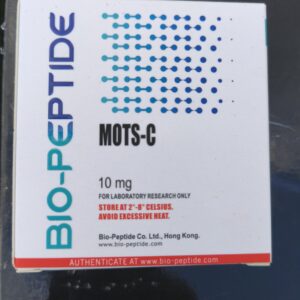
MOTS-c 10 mg by Bio-Peptide
45 EUR170,00 złAdd to cartIn stock
What is in this vial
It is the only MOTS-c vial in this catalogue. The powder has no concentration of its own: it is set when you add the water. This vial with 2 ml of bacteriostatic water gives 5 mg per millilitre, and with twice that volume, half as much.
The conversion of an amount into insulin syringe units is worked through in the guide on syringe units, and the rules that change once the powder is dissolved are in storage.
Bio-Peptide as the manufacturer
Bio-Peptide has the widest catalogue of the three brands we stock: it is the only one supplying glutathione, NAD+, GHK-Cu, MOTS-C, SLU-PP-332 and semaglutide, so an order from this manufacturer can usually be filled from one supplier. Every vial carries a code under the hologram and a batch certificate, and how to check both is described on the verification page.
What the evidence says
The animal work describes AMPK activation and better insulin sensitivity. Human data are observational correlations, so we do not write that it improves insulin sensitivity in people. The full account, with the sources and the limits, is on the MOTS-c page, and the background in the guide on MOTS-c, the peptide from the mitochondrion.
We publish no dosing schedules. Sold as research material, not as a medicine.
Concentration in this vial
| Water added | Concentration | Per unit on a U-100 syringe |
|---|---|---|
| 1 ml | 10 mg/ml | 100 mcg |
| 2 ml | 5 mg/ml | 50 mcg |
| 5 ml | 2 mg/ml | 20 mcg |
The table is arithmetic and nothing else: it converts the 10 mg in this vial into the concentration you get for a chosen volume of bacteriostatic water. It is not a dosing recommendation, and we publish none.
This vial next to the other MOTS-c vials
No other manufacturer here lists MOTS-c, so this is the only vial of it in the catalogue and there is no brand comparison to make.
Also from Bio-Peptide in this group
Within Weight loss peptides, Bio-Peptide also supplies Retatrutide 20 mg, Semaglutide 3 mg and SLU-PP-332 5 mg.
A peptide encoded in the mitochondria
Mitochondria have their own DNA, separate from the DNA in the cell nucleus. MOTS-c is written in a short open reading frame within the mitochondrial 12S rRNA gene and is 16 amino acids long. It belongs to the group called mitochondrial-derived peptides, described relatively recently.
The discovery of this group changed how mitochondria are seen. They used to be treated mainly as energy factories, not as organelles that send their own signals to the rest of the cell and to the whole body.
How it works and what AMPK is
The mechanism was described in a paper published in Cell Metabolism in 2015. MOTS-c inhibits the folate cycle and the purine synthesis linked to it, which leads to a build-up of the molecule AICAR and to activation of the kinase AMPK.
AMPK is the energy sensor of the cell. It switches on when energy runs short and moves the cell from storing energy to obtaining it. Glucose uptake and fatty acid oxidation rise, and fat storage falls. The same pathway is activated by physical exercise and by metformin.
What was shown in mice: faster clearance of glucose from the blood, better whole-body insulin sensitivity, prevention of age-related and high-fat-diet insulin resistance, and prevention of obesity from overfeeding. In mice on a high-fat diet, strong AMPK activation and higher expression of the glucose transporter GLUT4 in muscle were described.
What is known in humans, and what is not
Human data are observational, not interventional. Researchers measured people's own MOTS-c levels and checked what they go together with; they did not give MOTS-c and watch the result.
| Type of data | What was found |
|---|---|
| Correlations in humans | MOTS-c levels go together with BMI, waist circumference, fasting insulin, HOMA-IR and HbA1c |
| Specific groups | Lower levels in obese boys and adolescents, but not in girls |
| Interventional studies in humans | Few or none in the literature |
So we do not write that MOTS-c improves insulin sensitivity in people. We write that it works that way in mice, and that in people associations have been described that can mean many different things.
Who this vial is for
You are interested in mitochondrial metabolism and the AMPK pathway: this is the only such molecule in our range. You are looking for a molecule with interventional studies in humans: MOTS-c does not have them yet, and the incretins in the same category do.
MOTS-c, exercise and age in numbers
Calling it an exercise-mimicking peptide is backed by measurements in humans. In a 2021 paper in Nature Communications, ten young untrained men did a single bout of exercise. MOTS-c in their muscles rose about 12-fold, and in the blood about 1.5-fold. After four hours of rest the blood level was back to baseline.
A second paper, in Aging in 2020, compared men of different ages. Blood MOTS-c fell with age. In the muscles of middle-aged and older men, however, there was about 1.5 times more of it than in young men. The authors link this to a shift in muscle fibre type.
| What was studied | Model | Result |
|---|---|---|
| Dosing on a high-fat diet | mice | protection from obesity and insulin resistance |
| Dosing in old animals | mice | insulin sensitivity as in young animals after 7 days |
| Metabolic stress in the cell | cells | MOTS-c moves into the nucleus and changes gene activity |
| Single bout of exercise | humans | about 12 times more MOTS-c in muscle |
The last row concerns the body's own MOTS-c, which it makes itself. It is not a result of giving the peptide. No clinical trial of unmodified MOTS-c dosing has been completed. A longer-acting analogue, CB4211, went through early trial phases, after which its development ended.
In sport, MOTS-c is banned at all times. The 2026 WADA list names it in group S4, among metabolic modulators and AMPK activators. More on this molecule in the guide MOTS-c, the mitochondrial peptide.
Sources: Lee et al., Cell Metabolism 2015, Kim et al., Cell Metabolism 2018, Reynolds et al., Nature Communications 2021, D'Souza et al., Aging 2020, WADA Prohibited List 2026, Polish edition (POLADA).
Questions
How much MOTS-c is in this vial?
10 mg of lyophilised powder from Bio-Peptide, in one vial.
What concentration does 2 ml of water give?
5 mg per millilitre, which is 50 mcg per unit on a U-100 insulin syringe. Other volumes are in the table above.
Is MOTS-c available from another manufacturer here?
No. Bio-Peptide is the only manufacturer of MOTS-c in this catalogue.
Verification and delivery
Every vial carries a code under the hologram and comes from a batch with a certificate of analysis; how to check both is described in check your product. We ship within Poland and abroad. Outside Poland shipping costs 30 EUR paid in advance or 80 EUR cash on delivery, the same for every country: shipping and payments.