TB-500 10 mg reconstituted in 1 ml gives 10 000 mcg per millilitre, or 100 mcg per unit of a U-100 insulin syringe. The same vial in 2 ml gives 50 mcg per unit. The Nouveaux Ltd. two-chamber cartridge has a fixed 1 ml, so it always gives 100 mcg per mark. The most freedom comes with the Bio-Peptide vial for 35 EUR, because the kit has two ampoules and you choose the concentration yourself.
What is TB-500?
TB-500 is a short synthetic fragment of thymosin beta-4, a protein made of 43 amino acids. It covers the part of the molecule that binds actin, the protein that forms the skeleton of the cell, and so it is meant to help cell movement and tissue repair. How it differs from the other regeneration peptide is covered in TB-500 vs BPC-157.
No efficacy study of the TB-500 fragment itself has been published in humans. Full thymosin beta-4 was studied in humans as eye drops, not as injections. That is why this guide calculates only the concentration in the vial and does not recommend doses.
How many mcg are in one syringe unit after reconstitution?
A 10 mg vial is 10 000 mcg, so you divide that number by the millilitres of liquid. A U-100 insulin syringe has 100 units per 1 ml, so one unit is 0.01 ml.
| Pack | Liquid | Concentration | Per 1 U-100 unit | Per 10 U-100 units |
|---|---|---|---|---|
| 10 mg vial | 1 ml | 10 000 mcg/ml | 100 mcg | 1000 mcg |
| 10 mg vial | 2 ml | 5000 mcg/ml | 50 mcg | 500 mcg |
| 10 mg cartridge | 1 ml | 10 000 mcg/ml | 100 mcg | 1000 mcg |
With the vial you choose between 1 and 2 ml, and with 1 ml the solution is stronger and each mark carries 100 mcg. With 2 ml you measure more precisely, because a mistake of half a mark is 25 mcg instead of 50 mcg, and both 1 ml ampoules are already in the Bio-Peptide kit, so you buy no extra water.
These numbers are concentration arithmetic, not a dosing recommendation. The same calculation for other peptides is in how to convert a peptide amount into insulin syringe units.
What is known about thymosin beta-4 from human studies?
The best described study concerns eye drops with full thymosin beta-4. In a 2015 phase 2 trial, 72 people with dry eye took part. The primary endpoints did not differ from placebo, although eye discomfort in the test chamber fell by 27 percent as a secondary endpoint. No adverse events were reported in either group.
A 2012 review describes clinical trials on healing skin wounds and corneal injuries that were ongoing or planned when it was published. They concern the whole protein applied locally, not the TB-500 fragment by injection. What from animal and cell studies carries over to TB-500 is explained in TB-500: how long it takes to work in studies.
Which TB-500 pack to choose?
| Version | Pack | Per 1 U-100 unit | Price | Availability |
|---|---|---|---|---|
| TB-500 10 mg Bio-Peptide | vial and 2 ampoules of 1 ml | 100 or 50 mcg | 35 EUR | in stock |
| TB-500 10 mg Nouveaux Ltd. | two-chamber cartridge with 1 ml of solvent | 100 mcg | 45 EUR | in stock |
The Bio-Peptide vial is cheaper, 3.50 EUR per milligram against 4.50 EUR in the cartridge, and it is the one that gives you the choice between 1 and 2 ml.
You choose the Nouveaux Ltd. cartridge for convenience, because it has 10 mg of peptide in one chamber and 1 ml of solvent in the other, and you join the chambers before first use, with no ampoule and no transfer of liquid. The concentration is then always 10 000 mcg per millilitre and it cannot be diluted in a larger volume, because all the liquid is already inside.
Combining TB-500 with BPC-157? Buy both peptides separately, then you know the amount of each. Why these two are combined is explained in BPC-157 and TB-500 together. All versions are on the TB-500 page.
How to reconstitute a TB-500 vial step by step?
- Disinfect the rubber stopper of the vial and the neck of the solvent ampoule.
- Draw 1 ml of solvent, or 2 ml from both ampoules, into a syringe.
- Add the liquid slowly down the side of the vial, not straight onto the powder.
- Roll the vial gently between your fingers until the powder has fully dissolved.
- Do not shake the vial, because foam can damage the peptide molecules.
- Write the date and concentration on the vial, for example 5000 mcg/ml.
The ready solution should be clear, and the full procedure is in how to reconstitute peptides.
How to store TB-500?
The dry powder is stable, so the kit tolerates short shipping without a refrigerator. After reconstitution keep the solution in the refrigerator at 2-8 degrees, away from light. TB-500 has no approved drug label, so we give no use-by time for the solution.
Rules for lyophilisate and solution are in how to store peptides. You can check the authenticity of a vial as described in how to spot genuine peptides. TB-500 is research material, not a medicine, and it is banned in sport all year round, in section S2 of the WADA 2026 list, as described in BPC-157 and TB-500 and the WADA list.
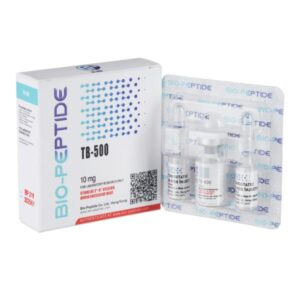
TB-500 10 mg by Bio-Peptide
35 EUR140,00 złAdd to cartIn stock
Ships within 24 h
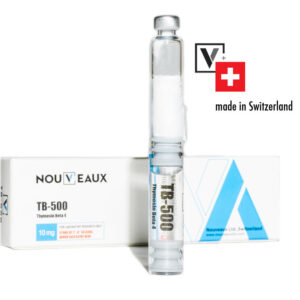
TB-500 10 mg by Nouveaux Ltd.
45 EUR180,00 złAdd to cartIn stock
Ships within 24 h
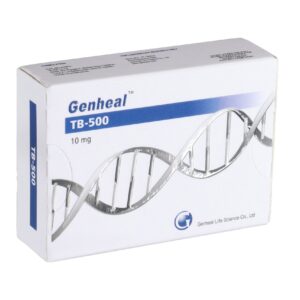
TB-500 10 mg by Genheal
35 EUR135,00 złAdd to cartIn stock
Ships within 24 h
Frequently asked questions
How many mcg of TB-500 are in one syringe unit?
With 10 mg in 1 ml one U-100 syringe unit holds 100 mcg, with 10 mg in 2 ml 50 mcg, and in the Nouveaux Ltd. cartridge with 1 ml it is always 100 mcg.
How much water to add to TB-500 10 mg?
You add 1 or 2 ml, and with 2 ml you get 5000 mcg per millilitre and more precise measuring. The Bio-Peptide version comes with two 1 ml ampoules.
How does the cartridge differ from the TB-500 vial?
Both versions hold 10 mg, but the cartridge has the solvent in a second chamber, so you prepare it without transferring liquid, and it gives one concentration, 100 mcg per unit.
Which TB-500 pack is cheaper?
The cheaper one is the Bio-Peptide 10 mg vial for 35 EUR, or 3.50 EUR per milligram, and the Nouveaux Ltd. 10 mg cartridge costs 45 EUR, or 4.50 EUR per milligram.
Does TB-500 need to be kept in the refrigerator?
You keep the solution after reconstitution in the refrigerator, at 2-8 degrees. The dry powder tolerates short shipping without a refrigerator.
Sources
- Goldstein AL, Hannappel E, Sosne G, Kleinman HK. Thymosin β4: a multi-functional regenerative peptide. Basic properties and clinical applications. Expert Opinion on Biological Therapy, 2012, 12(1): 37-51. https://pubmed.ncbi.nlm.nih.gov/22074294/
- Sosne G, Ousler GW. Thymosin beta 4 ophthalmic solution for dry eye: a randomized, placebo-controlled, Phase II clinical trial conducted using the controlled adverse environment (CAE) model. Clinical Ophthalmology, 2015, 9: 877-884. https://pubmed.ncbi.nlm.nih.gov/26056426/
- Di H, Huang J, Zhang D. Thymosin beta 4: An emerging therapeutic candidate for kidney diseases. Peptides, 2026, 195: 171467. https://pubmed.ncbi.nlm.nih.gov/41570941/