TB-500, 10 mg. TB-500 is a synthetic fragment of thymosin beta-4 covering the actin-binding section of that protein, bought alongside BPC-157 for soft tissue.
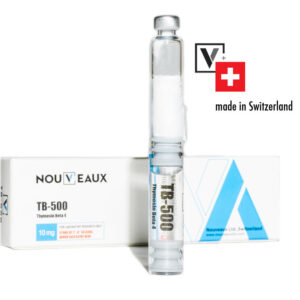
TB-500 10 mg by Nouveaux Ltd.
45 EUR180,00 złAdd to cartIn stock
What is in the pack
All three brands of TB-500 here hold the same 10 mg, so the choice between them is a choice of manufacturer and price, not of quantity. Nouveaux Ltd. supplies this product as a dual-chamber cartridge: 10 mg of freeze-dried powder in one chamber and 1 ml of solvent in the other. The chambers are joined just before first use, so no liquid has to be moved from one container to another. After activation with the included millilitre the solution stands at 10 mg per millilitre, which is 100 mcg per unit on a U-100 syringe.
The conversion of an amount into insulin syringe units is worked through in the guide on syringe units, and the rules that change once the powder is dissolved are in storage.
Nouveaux Ltd. as the manufacturer
Nouveaux Ltd. has the narrowest catalogue of the three and the largest packs: BPC-157 20 mg, CJC-1295 10 mg, sermorelin 10 mg, PEG-MGF 10 mg and follistatin 2 mg are all exclusive to this brand here. A larger pack costs less per milligram, and it also stands longer once dissolved, which is the trade-off to weigh before ordering.
What the evidence says
The mechanism rests on binding free actin. No completed efficacy trial in humans had been published for the fragment as of April 2026; the phase 3 data belong to full thymosin beta-4 as eye drops. The full account, with the sources and the limits, is on the TB-500 page, and the background in the guide on TB-500 compared with BPC-157.
We publish no dosing schedules. Sold as research material, not as a medicine.
Nouveaux Ltd. keeps the narrowest range of the three brands and builds it around larger packs and combination products. For TB-500 that shows up as a standard 10 mg cartridge, while the same brand supplies the 20 mg BPC-157 that is often ordered alongside it.
Concentration in this cartridge
| Total liquid | Concentration | Per unit on a U-100 syringe |
|---|---|---|
| 1 ml | 10 mg/ml | 100 mcg |
| 2 ml | 5 mg/ml | 50 mcg |
| 5 ml | 2 mg/ml | 20 mcg |
The table is arithmetic and nothing else: it converts the 10 mg in this cartridge into the concentration for a given total volume of liquid. The 1 ml row is the cartridge as supplied, after the chambers are joined; the other rows show what further dilution would give. It is not a dosing recommendation, and we publish none.
This cartridge next to the TB-500 vials
The same compound is sold here in two other versions: Bio-Peptide, 10 mg and Genheal, 10 mg. The molecule is identical in each; what differs is the manufacturer. All three hold the same amount, so the choice here is the manufacturer and its batch certificate, not the size.
Also from Nouveaux Ltd. in this group
Within Recovery peptides, Nouveaux Ltd. also supplies BPC-157 20 mg.
How actin binding is meant to work
Actin exists in the cell in two forms: free, globular molecules and filaments built from them. TB-500 is meant to bind the free form and make it harder for it to join into filaments. A cell that rebuilds its skeleton faster moves more easily, which is where the effects on cell migration and on the formation of new blood vessels described in the literature come from.
Thymosin beta-4 is present throughout the body, not in one organ, which is why TB-500 is studied for a systemic action. That sets it apart from BPC-157, described mainly as a peptide with a local action.
TB-500 and BPC-157 are two different molecules
These two peptides end up in the same basket so often that it is easy to treat them as variants of one thing. They are not. TB-500 is a synthetic fragment of thymosin beta-4, a protein of 43 amino acids present in many tissues. BPC-157 is a standalone peptide of 15 amino acids, based on a protein found in gastric juice.
| Feature | TB-500 | BPC-157 |
|---|---|---|
| Origin | Fragment of thymosin beta-4 | Fragment of a protein from gastric juice |
| Structure | Short section of a larger protein | Standalone peptide of 15 amino acids |
| Described action | Studied as systemic | Described mainly as local |
| Human data | No completed efficacy studies for the fragment | One small observational study |
| Status in sport | Prohibited at all times, category S2 | Prohibited at all times |
The full comparison with sources is in the guide on TB-500 versus BPC-157.
What TB-500 actually is
TB-500 is often confused with thymosin beta-4, and they are not the same thing. Thymosin beta-4 is a natural protein of 43 amino acids present in many tissues. TB-500 is a short section of it made in a laboratory, covering the actin-binding part described by the sequence Ac-LKKTETQ. What is in the pack is a fragment, not the whole protein, and that difference comes back in every honest account of the research.
The cartridge in practice
The Nouveaux Ltd. pack is a dual-chamber cartridge: 10 mg of powder in one chamber and 1 ml of solvent in the other. The chambers are joined just before first use, so nothing has to be transferred between containers. After activation the solution stands at 10 mg per millilitre, or 100 mcg per unit on a U-100 syringe, and a mistake of one mark on the syringe changes the amount by 100 mcg. Let it dissolve on its own, without shaking, and keep the activated cartridge in the fridge at 2 to 8 degrees Celsius, away from light.
Who this cartridge is for
You want TB-500 with nothing to prepare: this is the pack. You want a weaker solution and a finer scale: the Bio-Peptide box has two 1 ml ampoules. You want TB-500 together with BPC-157 in one vial: there is a ready blend of both.
Studies of the fragment that is actually in the cartridge
TB-500 is not the whole of thymosin beta-4, a protein of 43 amino acids. It corresponds to a short actin-binding section of it, described by the sequence LKKTETQ. Most studies concern full thymosin. Two 2003 papers, however, tested exactly this seven-amino-acid section, and they describe best what the contents of this cartridge do.
| Study | Model | What was found |
|---|---|---|
| Philp et al., FASEB Journal 2003 | human endothelial cells and blood vessels of chick embryos | the actin-binding section stimulated cell migration and new vessel formation just like full thymosin, at a concentration of about 50 nM |
| Philp et al., Wound Repair and Regeneration 2003 | diabetic mice, 26-month-old mice, rats | the LKKTETQ peptide sped up the healing of skin wounds; in diabetic mice the wound was almost closed after 8 days |
The first paper also included a reverse test. Adding free actin at 5 to 50 nM blocked the peptide's effect. This confirms that the key is binding actin, the protein responsible for cell movement.
The second paper is interesting because of its models. Wounds in diabetic mice and in old animals heal slowly, just as in people with the same problems. The short synthetic peptide worked in them much like the full molecule.
What these studies do not tell us
Both papers concern cells and animals. No completed efficacy studies in humans have been published for the TB-500 fragment itself. Clinical trials were run for full thymosin beta-4 as eye drops, not as injections for injuries. TB-500 is on the WADA list in category S2, banned at all times. The differences from BPC-157 are described in the guide TB-500 and BPC-157.
Sources: Philp et al., FASEB Journal 2003, Philp et al., Wound Repair and Regeneration 2003.
Questions
How much TB-500 is in this cartridge?
10 mg of lyophilised powder from Nouveaux Ltd., in a dual-chamber cartridge with 1 ml of solvent.
What concentration does the included millilitre give?
10 mg per millilitre, which is 100 mcg per unit on a U-100 insulin syringe. Other volumes are in the table above.
Is this the same molecule as the Bio-Peptide vial?
Yes. TB-500 is the same compound in every pack here, and both hold 10 mg. What differs is the manufacturer and the batch certificate that comes with it.
Verification and delivery
Every pack carries a code under the hologram and comes from a batch with a certificate of analysis; how to check both is described in check your product. We ship within Poland and abroad. Outside Poland shipping costs 30 EUR paid in advance or 80 EUR cash on delivery, the same for every country: shipping and payments.