IGF-1 LR3, 1 mg. IGF-1 LR3 is a modified analogue of insulin-like growth factor 1, built to bind carrier proteins weakly and stay active longer than the natural molecule.
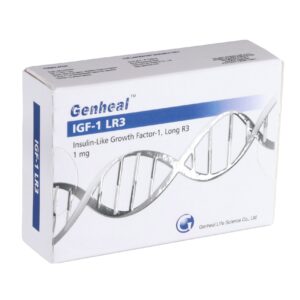
IGF-1 LR3 1 mg by Genheal
65 EUR250,00 złAdd to cartAvailable on backorder
What is in this vial
All three brands of IGF-1 LR3 here come in the same 1 mg vial, so the choice between them is a choice of manufacturer and price, not of quantity. The powder has no concentration of its own: it is set when you add the water. This vial with 1 ml of bacteriostatic water gives 1 mg per millilitre, and with twice that volume, half as much.
The conversion of an amount into insulin syringe units is worked through in the guide on syringe units, and the rules that change once the powder is dissolved are in storage.
Genheal as the manufacturer
Genheal covers the growth hormone axis more completely than the other two brands and is the only one here supplying the BPC-157 and TB-500 blend and tesamorelin. Its vials carry a code under the hologram and a batch certificate, checked the same way as any other brand in this shop.
What the evidence says
No human pharmacokinetic study of this analogue has been published, and there are no efficacy or safety data for muscle applications. Hypoglycaemia is the risk most often listed. The full account, with the sources and the limits, is on the IGF-1 LR3 page, and the background in the guide on IGF-1 LR3 and DES(1-3) IGF-1.
We publish no dosing schedules. Sold as research material, not as a medicine.
Genheal covers both IGF-1 modifications sold here, LR3 and DES(1-3), each in a 1 mg vial. The practical difference between them is duration: roughly 20 to 30 hours against 20 to 30 minutes, which is a decision about the kind of exposure rather than about strength.
Concentration in this vial
| Water added | Concentration | Per unit on a U-100 syringe |
|---|---|---|
| 1 ml | 1 mg/ml | 10 mcg |
| 2 ml | 0.5 mg/ml | 5 mcg |
| 5 ml | 0.2 mg/ml | 2 mcg |
The table is arithmetic and nothing else: it converts the 1 mg in this vial into the concentration you get for a chosen volume of bacteriostatic water. It is not a dosing recommendation, and we publish none.
This vial next to the other IGF-1 LR3 vials
The same compound is sold here in two other versions: Bio-Peptide, 1 mg and Nouveaux Ltd., 1 mg. The molecule is identical in each; what differs is the manufacturer. All three hold the same amount, so the choice here is the manufacturer and its batch certificate, not the size.
Also from Genheal in this group
Within Muscle peptides, Genheal also supplies ACE-031 10 mg, DES(1-3) IGF-1 1 mg and Follistatin 344 1 mg.
What the IGF-1 axis is and why it is targeted
IGF-1 is a growth factor that, once bound to its receptor, switches on the pathway labelled PI3K, Akt and mTOR. This pathway increases muscle protein synthesis and slows protein breakdown by blocking proteins of the FOXO family. It also stimulates satellite cells, which take part in building muscle fibres. That mechanism is the basis of all the interest in this group, but it describes what natural IGF-1 does in the body, not what giving its analogue from outside achieves.
What LR3 means
Natural IGF-1 circulates in the blood bound to carrier proteins that limit its availability. The LR3 modification changes the molecule so that it binds to them more weakly, and as a result it stays in its active form for longer. The way it acts on the receptor stays the same; what changes is how available the molecule is.
Risks listed for this molecule
| Risk | What it involves |
|---|---|
| Hypoglycaemia | A drop in blood sugar |
| Suppression of the body's own axis | Feedback in the hypothalamus and pituitary dampens growth hormone and IGF-1 release, described in animals |
The second risk matters because it concerns the very system that was meant to be strengthened: giving a growth factor from outside can lower the body's own production, which is how most hormonal loops work.
Measuring with a 1 mg vial
Typical peptide packs hold 5 or 10 mg. Here you have 1 mg, so after dissolving in one millilitre you get 1000 mcg per millilitre, or 10 mcg per insulin syringe unit. That is ten times less than a 10 mg vial dissolved the same way, so work it out before the first draw rather than carrying over a habit from another product. IGF-1 LR3 is on the World Anti-Doping Agency list in category S2 and is prohibited at all times.
Why LR3 acts more strongly although it binds the receptor more weakly
LR3 was described in 1992 by researchers at the Australian science agency CSIRO in Adelaide. It differs from natural IGF-1 in two changes. At position three of the chain, glutamic acid was replaced by arginine, and a short stretch of extra amino acids was added at the start.
Both changes mean that LR3 hardly binds to the IGF binding proteins, the IGFBPs. At the same time it binds the IGF-1 receptor itself about 3 times more weakly than the natural factor. Even so it acted more strongly in studies, simply because more of it reached the receptor.
- Rat muscle cells, 1992: the extended versions of IGF-1 stimulated protein and DNA synthesis and held back protein breakdown more strongly than ordinary IGF-1. LR3 was the strongest, on a par with DES(1-3) IGF-1.
- The reverse test: in cells that do not secrete IGFBP proteins, LR3 acted more weakly than ordinary IGF-1. This confirmed that its strength comes from bypassing the binding proteins.
The fall in blood sugar in numbers
IGF-1 acts similarly to insulin and lowers blood sugar. In a 1997 study in pigs and marmosets, the variants with weak IGFBP binding lowered blood sugar 2 to 3 times more strongly than ordinary IGF-1. The fall lasted longer, and the total effect over four hours was about 2 times greater at doses of equal potency.
This has not been studied in humans, because no clinical trials of LR3 have been published. The risk of low blood sugar when working with this molecule therefore has concrete backing in animal data. The differences between LR3 and the other modification are described in the guide IGF-1 LR3 and DES(1-3) IGF-1.
Sources: Francis et al., Journal of Molecular Endocrinology 1992, Tomas et al., Journal of Endocrinology 1997.
Questions
How much IGF-1 LR3 is in this vial?
1 mg of lyophilised powder from Genheal, in one vial.
What concentration does 2 ml of water give?
0.5 mg per millilitre, which is 5 mcg per unit on a U-100 insulin syringe. Other volumes are in the table above.
Is this the same molecule as the Bio-Peptide vial?
Yes. IGF-1 LR3 is the same compound in every vial here, and both hold 1 mg. What differs is the manufacturer and the batch certificate that comes with it.
Verification and delivery
Every vial carries a code under the hologram and comes from a batch with a certificate of analysis; how to check both is described in check your product. We ship within Poland and abroad. Outside Poland shipping costs 30 EUR paid in advance or 80 EUR cash on delivery, the same for every country: shipping and payments.