rHGH is ready-made growth hormone, while GHRH and GHRP peptides are signals that tell the pituitary to release its own. Everything else follows from that one difference: what the effect depends on, how long it lasts and what it costs. Somatropin works without the pituitary, so the amount of hormone in the blood depends on how much is given. A stimulating peptide gives as much as the pituitary is able to release. Below you will find both routes compared in a table, results from human studies and the prices of every version in the shop.
What is rHGH?
rHGH is somatropin, recombinant human growth hormone. According to the label of the drug Genotropin, it is a protein of 191 amino acids with a mass of 22,124 daltons. Its sequence is identical to the hormone our pituitary releases. It is produced by recombinant DNA technology in E. coli bacteria.
The same substance is the active ingredient of prescription drugs. The Genotropin label covers, among others, adults with growth hormone deficiency. In the shop somatropin is sold as research material in two versions: rHGH 4 mg (12 IU) by Bio-Peptide and rHGH 12 mg (36 IU) by Nouveaux Ltd. Both are on the rHGH (somatropin) page.
How do growth hormone peptides work?
Growth hormone peptides contain no hormone. They give the pituitary a signal to release it and fall into two groups that act through different receptors:
- GHRH analogues, that is analogues of growth hormone releasing hormone: sermorelin (the 1-29 segment of that molecule), Mod GRF 1-29, CJC-1295 and tesamorelin (an analogue of the full GHRH molecule);
- GHRP peptides, which act through the ghrelin receptor: ipamorelin, GHRP-2, GHRP-6 and hexarelin.
The two groups are often paired, because each stimulates the pituitary by a different route. Both routes are explained in Growth hormone peptides: GHRH, GHRP and ghrelin.
How does rHGH differ from stimulating peptides?
In short, rHGH replaces the hormone and a peptide stimulates its release. The table lists the other differences.
| Feature | rHGH (somatropin) | GHRH and GHRP peptides |
|---|---|---|
| What enters the body | ready-made growth hormone | a signal for the pituitary |
| Role of the pituitary | not needed | required |
| Structure | a protein of 191 amino acids | short amino acid chains |
| Approved drug | yes, for example Genotropin | currently only tesamorelin (Egrifta) |
| Content stated in | mg and IU (1 mg is 3 IU) | mg |
| Price in the shop | from 25 EUR for 4 mg | from 25 EUR for 5 mg of CJC-1295 |
The 3 IU per milligram conversion comes from the international standard for somatropin. That is why 4 mg is 12 IU and 12 mg is 36 IU, as explained in IU and milligrams.
What does the effect depend on in each group?
With rHGH the effect depends mainly on the amount of hormone given. In a 1990 study, 21 healthy men aged 61 to 81 had low IGF-1, below 350 units per litre. In the 12 who received somatropin, IGF-1 rose into the range typical of young adults, 500 to 1500 units per litre. In the untreated group it stayed below 350.
With peptides the effect depends on the pituitary response, and its time course is set by the peptide. In healthy volunteers ipamorelin produced a single growth hormone pulse that peaked after about 40 minutes. The peptide itself left the blood with a half-life of 2 hours. CJC-1295 with DAC lasted longer: after one injection growth hormone was 2 to 10 times higher for at least 6 days, and IGF-1 was 1.5 to 3 times higher for 9 to 11 days.
Both routes raise growth hormone and IGF-1, but at a different rhythm. The time course of each peptide is covered in Ipamorelin: results in studies and CJC-1295 with DAC: results day by day.
Does age change the choice?
Age matters, because we release less growth hormone as we get older. The authors of the 1990 study concluded that this lower secretion is partly responsible for the loss of lean mass, the gain in fat and the thinner skin of old age. Over 6 months somatropin gave these men 8.8 percent more lean body mass and 14.4 percent less fat tissue.
Stimulating peptides are also studied in older people, and the results are collected in Sermorelin after 50. What happens to the growth hormone axis after forty is described in Peptides after 40. With rHGH the amount of hormone does not depend on how much the pituitary can still release.
How much do both routes cost in the shop?
The full hormone and the cheapest stimulating peptide both start at 25 EUR.
| Product | Group | Content | Price |
|---|---|---|---|
| rHGH Bio-Peptide | somatropin | 4 mg, 12 IU | 25 EUR |
| rHGH Nouveaux Ltd. | somatropin | 12 mg, 36 IU | 90 EUR |
| CJC-1295 Genheal | GHRH analogue | 5 mg | 25 EUR |
| Sermorelin Genheal | GHRH analogue | 5 mg | 40 EUR |
| Ipamorelin Genheal | GHRP | 10 mg | 40 EUR |
| Ipamorelin and CJC-1295 Nouveaux Ltd. | GHRH and GHRP pair | 10 mg | 40 EUR |
Per unit, the Bio-Peptide vial costs about 2.08 EUR per IU and the Nouveaux Ltd. cartridge about 2.50 EUR. The cartridge holds three times as much and has the solvent sealed in a second chamber.
Which one to choose?
The choice depends on what you expect. If you want ready-made hormone whose amount does not depend on the pituitary, and the lowest price per unit, choose rHGH 4 mg by Bio-Peptide. If you prefer a larger supply and preparation without transferring liquid, choose rHGH 12 mg by Nouveaux Ltd. If you want to stimulate your own secretion, start with ipamorelin or the pair with CJC-1295 described in why CJC-1295 is paired with ipamorelin.
Somatropin and all peptides in the shop are research material, not medicines. Growth hormone and the peptides that stimulate its release are banned in sport all year round: the WADA 2026 list names somatropin in group S2.2.3, and GHRH analogues, ipamorelin and GHRP peptides in group S2.2.4.
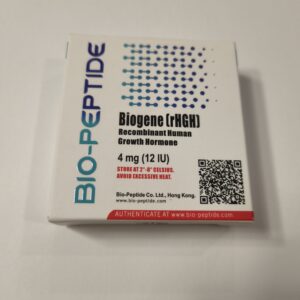
rHGH 4 mg (12 IU) by Bio-Peptide
25 EUR100,00 złAdd to cartIn stock
Ships within 24 h
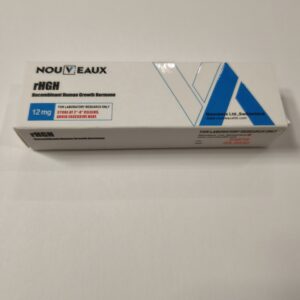
rHGH 12 mg (36 IU) by Nouveaux Ltd.
90 EUR350,00 złAdd to cartIn stock
Ships within 24 h

Sermorelin Acetate 5 mg by Bio-Peptide
40 EUR150,00 złAdd to cartIn stock
Ships within 24 h

Sermorelin Acetate 5 mg by Genheal
40 EUR150,00 złAdd to cartIn stock
Ships within 24 h

Sermorelin Acetate 10 mg by Nouveaux Ltd.
75 EUR300,00 złAdd to cartIn stock
Ships within 24 h

CJC-1295 5 mg by Bio-Peptide
25 EUR95,00 złAdd to cartIn stock
Ships within 24 h
Frequently asked questions
How does rHGH differ from ipamorelin?
rHGH is ready-made growth hormone and works without the pituitary. Ipamorelin makes the pituitary release its own hormone and in a study produced one pulse that peaked after about 40 minutes.
Do growth hormone peptides contain growth hormone?
No. GHRH analogues and GHRP peptides are signals for the pituitary. The pituitary then releases the growth hormone itself.
How many IU are in 1 mg of somatropin?
Under the international standard for somatropin, 1 mg is 3 IU. That is why 4 mg is 12 IU and 12 mg is 36 IU.
Which growth hormone peptide is an approved drug?
Currently only tesamorelin is, under the name Egrifta. Somatropin is the active ingredient of several prescription drugs, including Genotropin.
How much does rHGH cost in the shop?
The 4 mg (12 IU) vial by Bio-Peptide costs 25 EUR and the 12 mg (36 IU) cartridge by Nouveaux Ltd. costs 90 EUR.
Sources
- GENOTROPIN (somatropin) for injection, prescribing information, Pfizer, version of 4 August 2026 (DailyMed, set ID ffebf88b-d257-4542-9808-74d9b7167765). https://dailymed.nlm.nih.gov/dailymed/drugInfo.cfm?setid=ffebf88b-d257-4542-9808-74d9b7167765
- Rudman D, Feller AG, Nagraj HS et al. Effects of human growth hormone in men over 60 years old. New England Journal of Medicine, 1990, 323(1): 1-6. https://pubmed.ncbi.nlm.nih.gov/2355952/
- Gobburu JV, Agersø H, Jusko WJ, Ynddal L. Pharmacokinetic-pharmacodynamic modeling of ipamorelin, a growth hormone releasing peptide, in human volunteers. Pharmaceutical Research, 1999, 16(9): 1412-1416. https://pubmed.ncbi.nlm.nih.gov/10496658/
- Teichman SL, Neale A, Lawrence B et al. Prolonged stimulation of growth hormone (GH) and insulin-like growth factor I secretion by CJC-1295, a long-acting analog of GH-releasing hormone, in healthy adults. Journal of Clinical Endocrinology and Metabolism, 2006, 91(3): 799-805. https://pubmed.ncbi.nlm.nih.gov/16352683/